Skip to the stories

221b.au 1890–2026

Sherlock Holmes in Australia

In 1891 Holmes went after a Ballarat bushranger, and Sidney Paget drew him in a deerstalker for the first time to do it. Australians first saw him on the stage in Perth in 1902; his author came in 1920 to lecture on the dead; by 1924 he was selling cough mixture. Derham Groves, invested in the Baker Street Irregulars in 1985 as Black Jack of Ballarat, has written, printed and collected him since 1981.

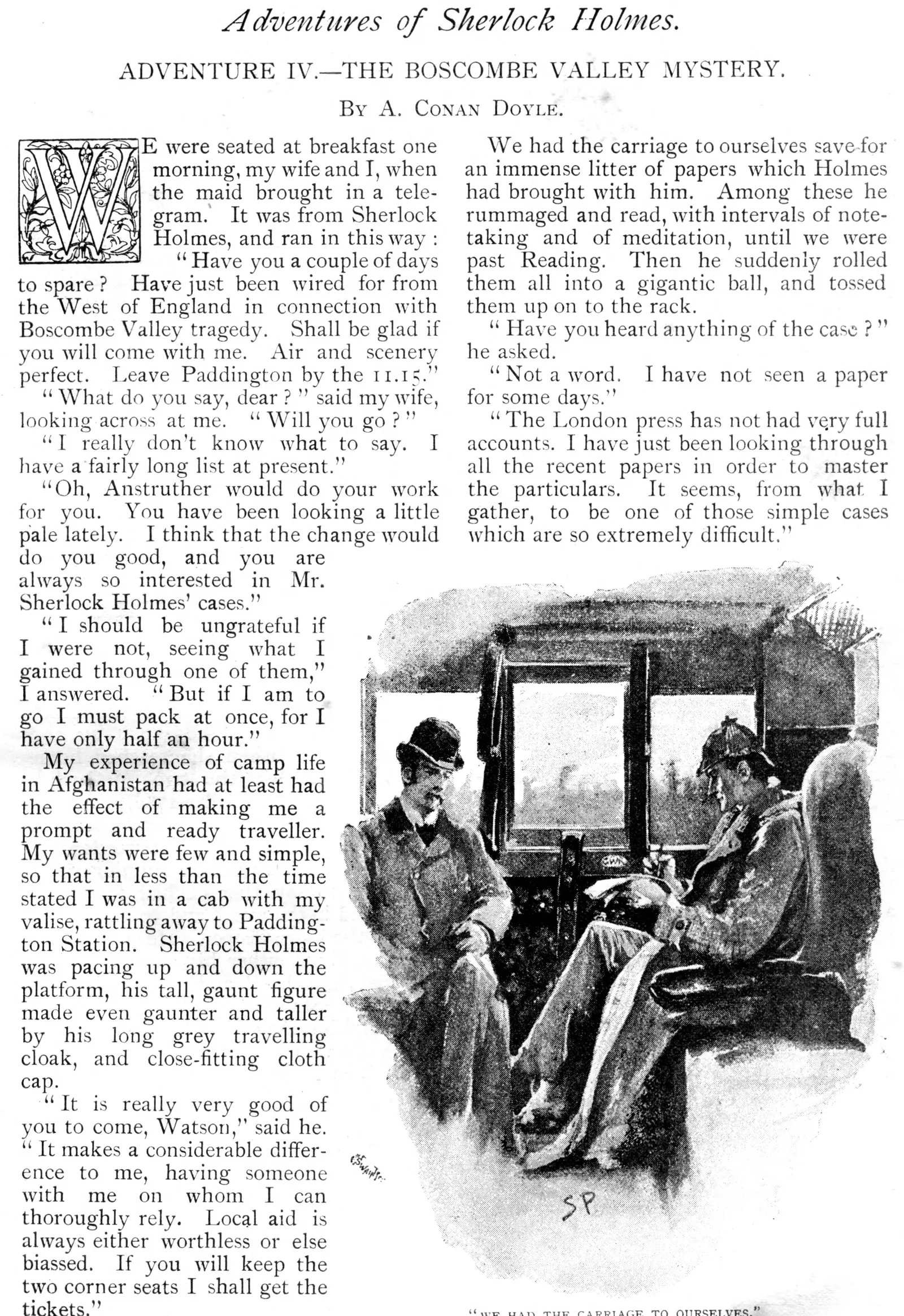
The first page of “The Boscombe Valley Mystery” in The Strand Magazine, October 1891: two columns of type under the heading “Adventures of Sherlock Holmes. Adventure IV.—The Boscombe Valley Mystery. By A. Conan Doyle”, and Sidney Paget’s drawing of Holmes and Watson facing each other in a railway carriage, Holmes in a deerstalker and a long cloak with newspapers on his knee, Watson in a bowler; under it, “We had the carriage to ourselves.”
The Strand Magazine, October 1891, page 401: the Ballarat story, and Paget’s first Holmes in a deerstalker. The lens on every cutting on this page shows the printed page at its full size, and reads down it as the cutting passes. Sidney Paget; The Strand Magazine, no. 10, via Internet Archive

1890–1924 In the stories

Black Jack of Ballarat

In “The Boscombe Valley Mystery”, in The Strand Magazine of October 1891, Charles McCarthy, who had been in Australia, is found dead by the Boscombe Pool in Herefordshire. His son heard him call “Cooee!”, which Holmes points out is “a distinctly Australian cry”, and then something about “a rat”. Holmes sends to Bristol for a map of the Colony of Victoria, covers part of it with his hand, and lets Watson read ARAT, then BALLARAT. The murderer is McCarthy’s landlord, John Turner, who robbed a gold convoy on its way from Ballarat to Melbourne in the early sixties and has lived on it since. “Black Jack of Ballarat was the name I went under,” he confesses, “and our party is still remembered in the colony as the Ballarat Gang.” McCarthy had driven the wagon.

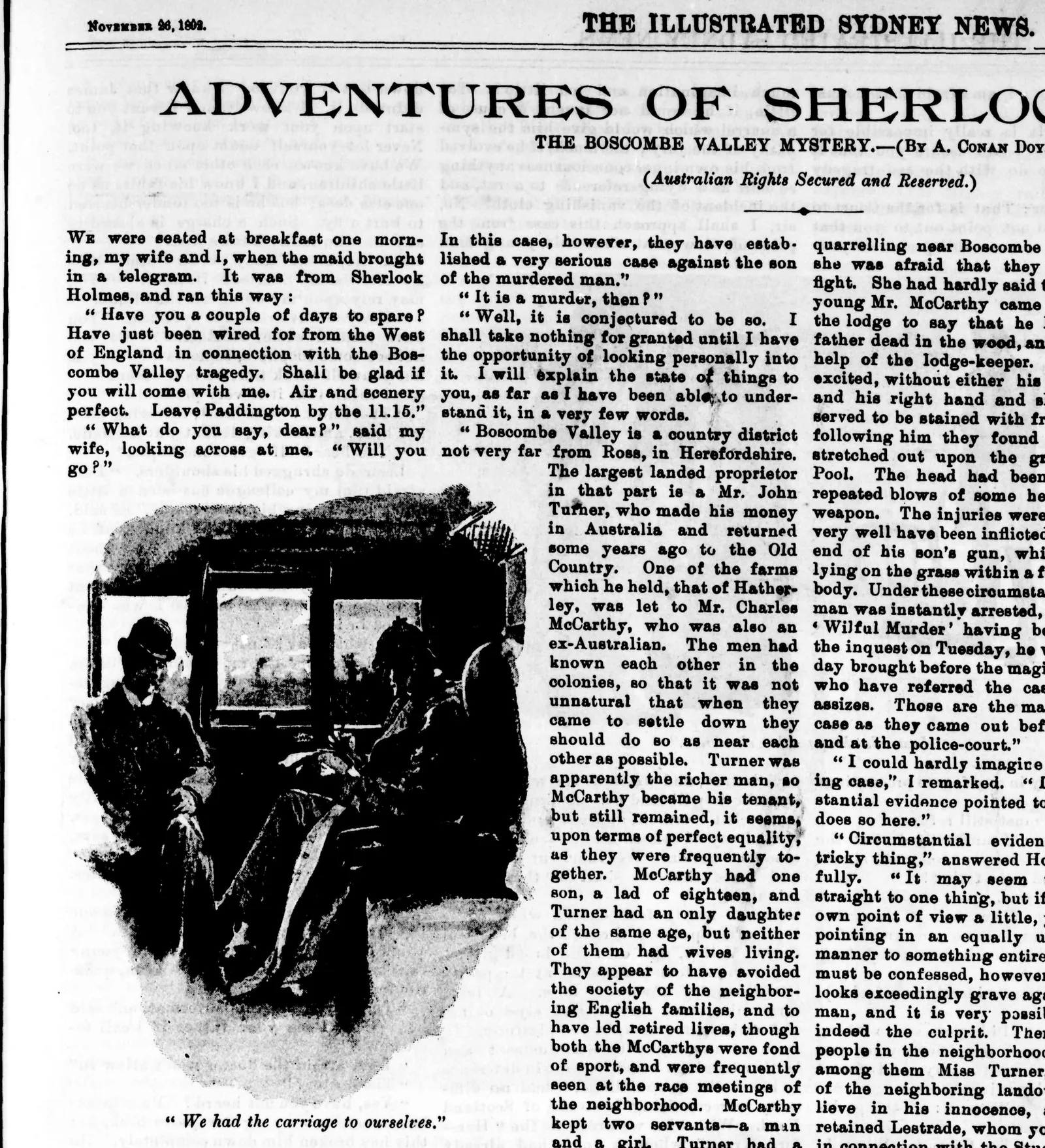
Sidney Paget drew Holmes on his way there, in a railway carriage, in a deerstalker: the first he gave him. The text says only “close-fitting cloth cap”. The Strand had been on sale in Hobart and Launceston since its first number, and thirteen months later the Illustrated Sydney News printed the story with Paget’s carriage and all, under “Australian Rights Secured and Reserved.”

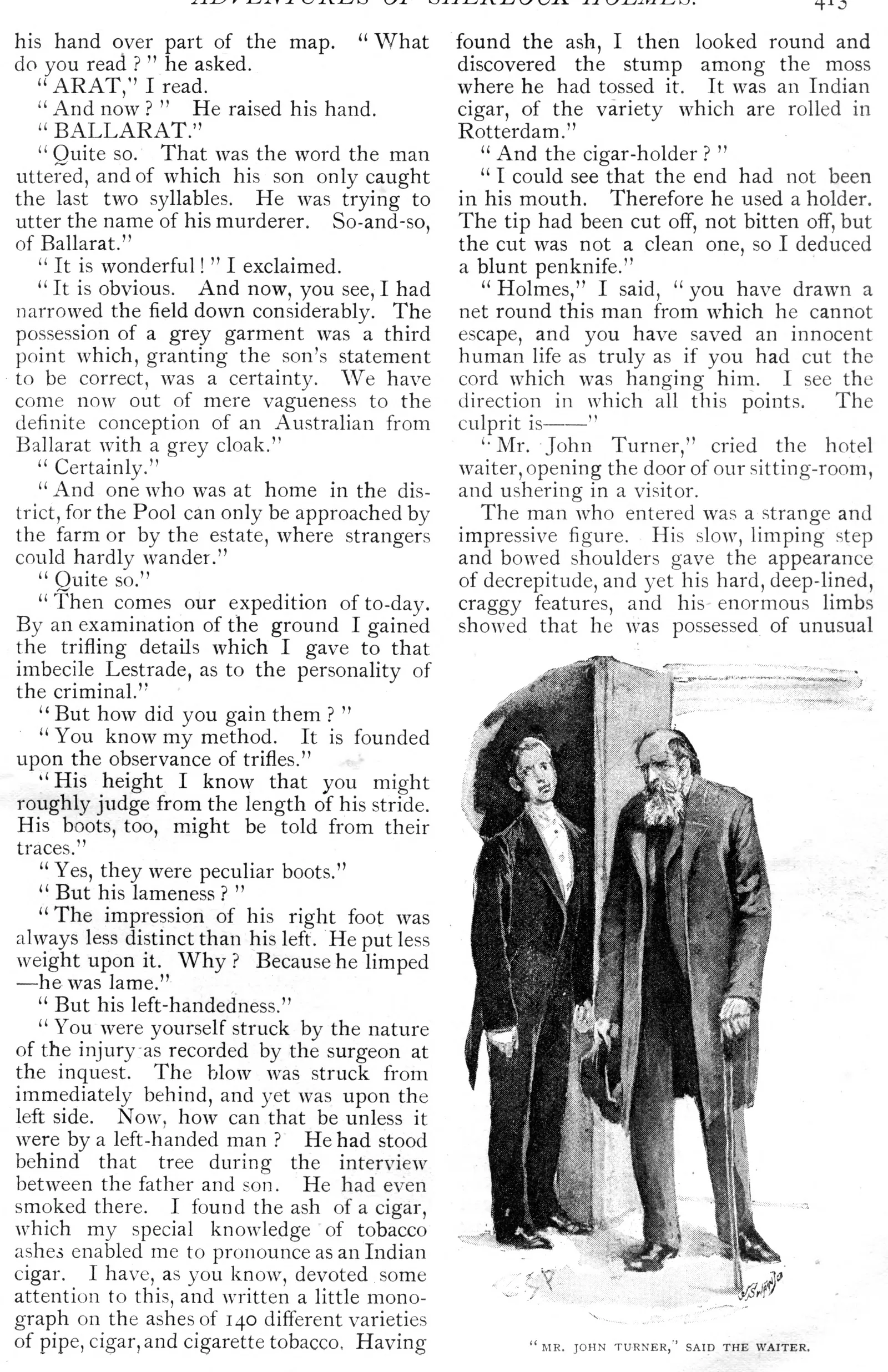
Page 413 of the Strand, October 1891. In the left column Holmes covers part of a map of Victoria: “What do you read?” “ARAT,” I read. “And now?” He raised his hand. “BALLARAT.” In the right column Paget draws John Turner, a huge bent old man with a white beard and a stick, shown in by a young waiter: “Mr. John Turner,” said the waiter.
“ARAT … BALLARAT.” The Strand, October 1891, page 413, and Paget’s John Turner, Black Jack of Ballarat. Sidney Paget; The Strand Magazine, no. 10, via Internet Archive
A page of the Illustrated Sydney News: “Adventures of Sherlock Holmes: The Boscombe Valley Mystery.—(By A. Conan Doyle.) (Australian Rights Secured and Reserved.)” across the top, Paget’s railway carriage, heavily printed, under it “We had the carriage to ourselves”, and the story’s first columns.
The Ballarat story in Sydney, thirteen months on, Paget’s carriage and all: “Australian Rights Secured and Reserved.” Illustrated Sydney News, 26 November 1892, page 11, via Trove

Australia comes into the stories again and again. In The Sign of the Four (1890) Mary Morstan has seen ground dug over like the treasure-seekers’ “on the side of a hill near Ballarat, where the prospectors had been at work”. “The ‘Gloria Scott’” (1893) is Holmes’s first case: a convict barque bound for Australia in 1855, taken by its convicts and blown up, and two of its convicts, landed at Sydney, make their fortunes on the diggings. When Holmes takes down his great index in “The Sussex Vampire” (1924), the first entry he reads under V is “Voyage of the Gloria Scott”.

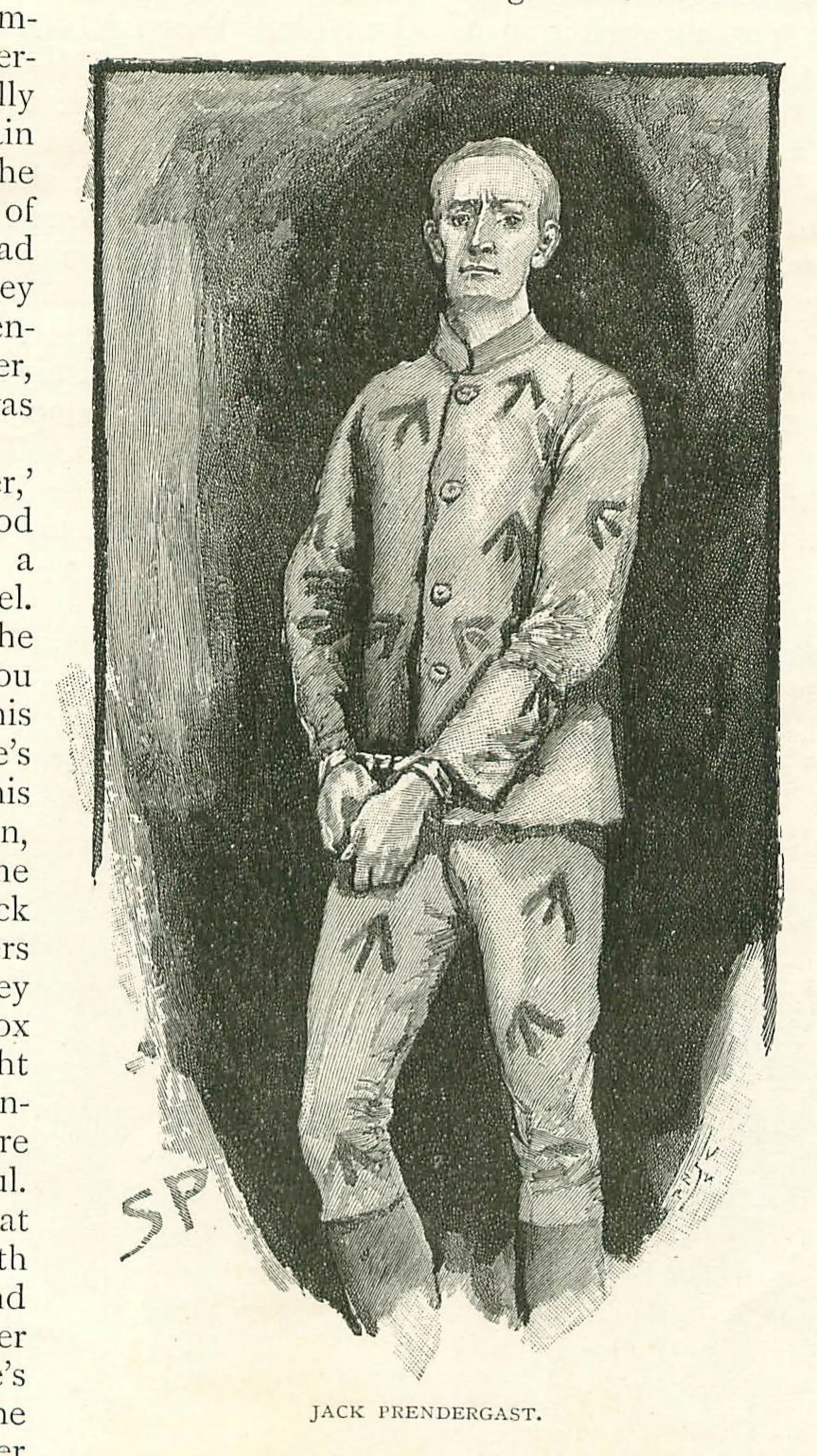
Paget’s drawing of a convict standing full length in a prison suit covered with broad arrows, his wrists manacled in front of him, captioned “Jack Prendergast”.
Jack Prendergast, who took the Gloria Scott on her way to Australia. The Strand, April 1893. Sidney Paget; The Strand Magazine, vol. 5, via Internet Archive

In “The Abbey Grange” (1904) Lady Brackenstall is Mary Fraser of Adelaide, “brought up in the freer, less conventional atmosphere of South Australia”, and the man who loves her is Jack Croker, an officer on the Adelaide–Southampton line. In “The Empty House” (1903) the murdered Ronald Adair is the son of the governor of an Australian colony, and in “The Disappearance of Lady Frances Carfax” (1911) the villain is Holy Peters, “one of the most unscrupulous rascals that Australia has ever evolved”.

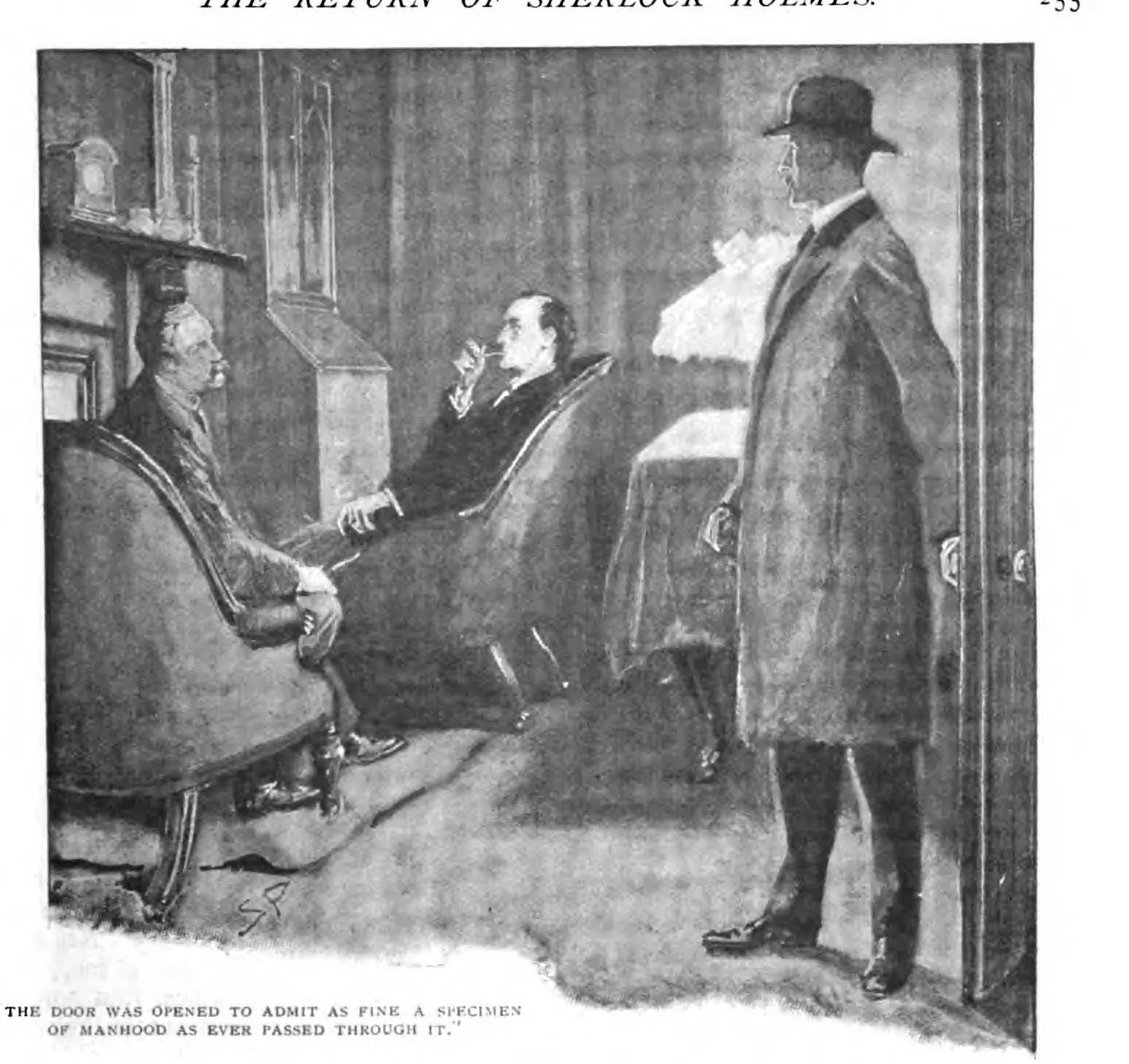
Paget’s drawing of the sitting room at Baker Street at night: a tall man in an overcoat and bowler stands at the open door while Holmes, with his pipe, and Watson sit by the fire. Captioned “The door was opened to admit as fine a specimen of manhood as ever passed through it.”
Captain Jack Croker, of the Adelaide–Southampton line, at Baker Street. The Strand, September 1904. Sidney Paget; The Strand Magazine, vol. 28, via Internet Archive

Sources Doyle, “The Boscombe Valley Mystery”, The Adventures of Sherlock Holmes; The Strand Magazine, no. 10, October 1891, pp. 401–416; Illustrated Sydney News, 26 November 1892; The Mercury, 31 January 1891; The Sign of the Four; “The ‘Gloria Scott’”, The Memoirs of Sherlock Holmes; “The Abbey Grange” and “The Empty House”, The Return of Sherlock Holmes; “The Disappearance of Lady Frances Carfax”, His Last Bow; “The Sussex Vampire”, The Case-Book of Sherlock Holmes; The Arthur Conan Doyle Encyclopedia.

1902–1948 On the stage, and on the air

Australia’s first Sherlock Holmes: Perth, 26 July 1902

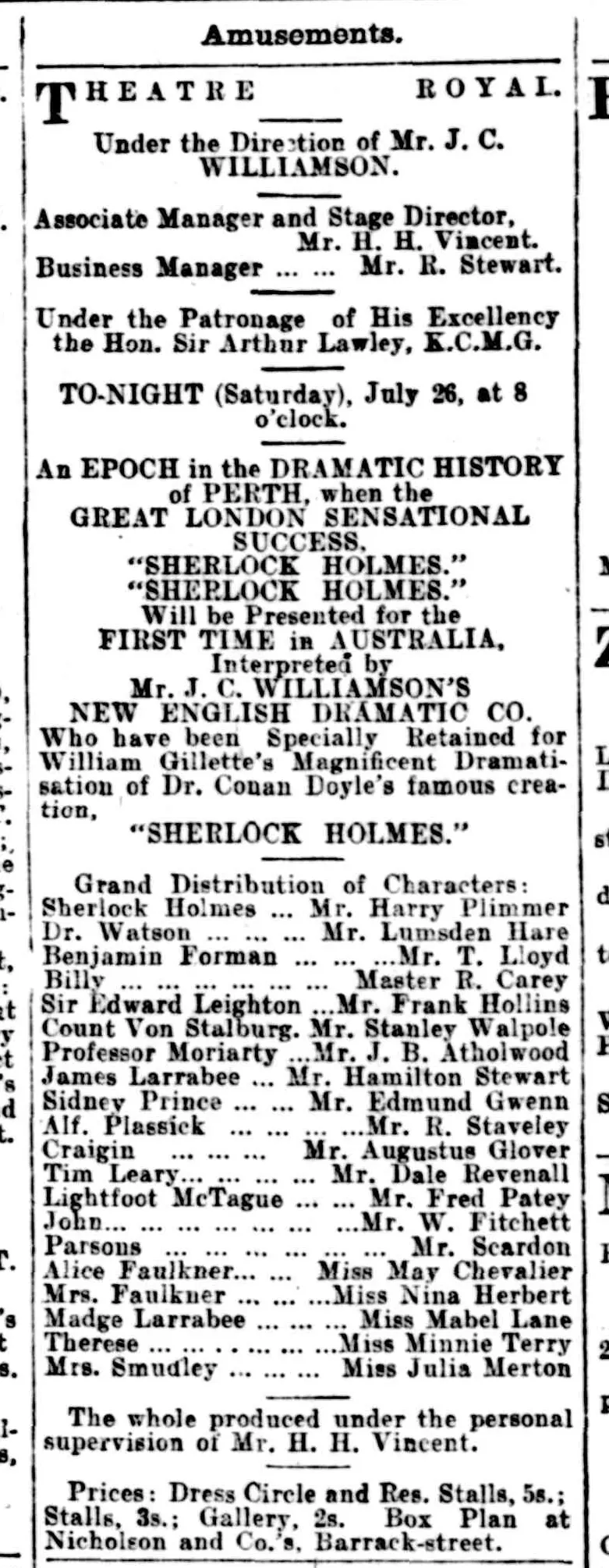
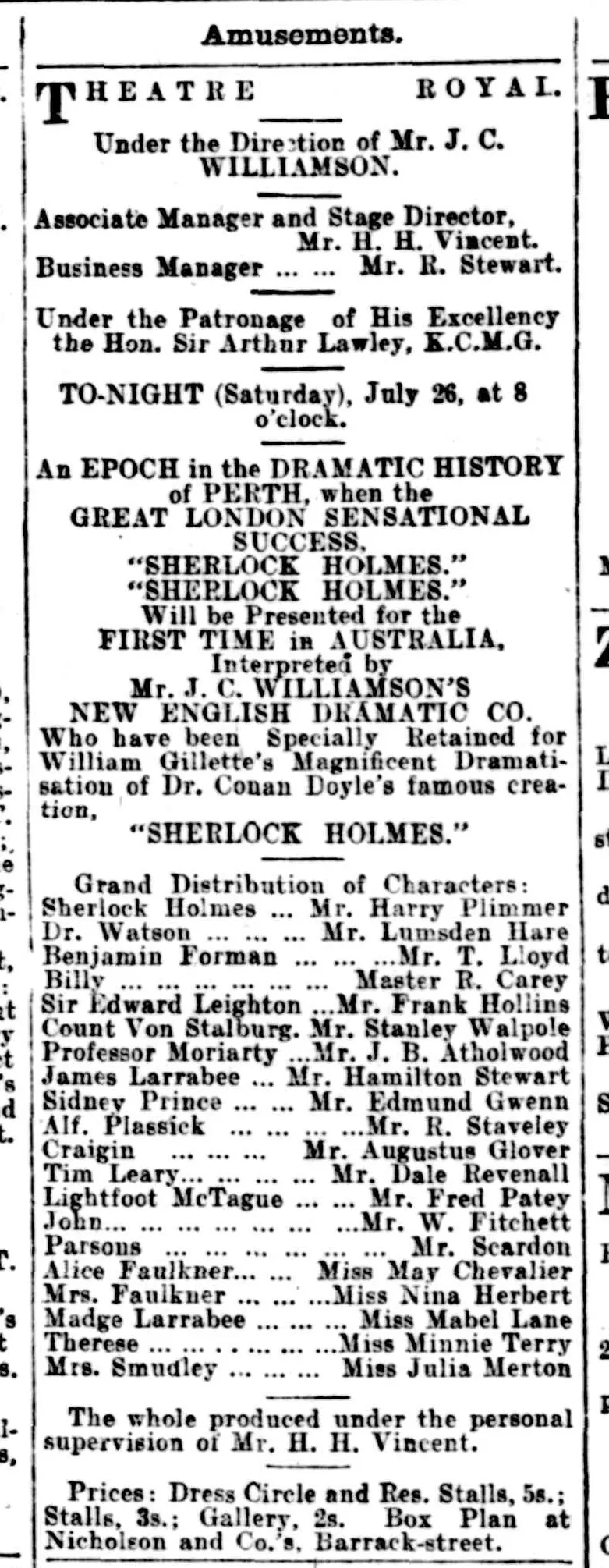
J. C. Williamson paid a thousand pounds for the Australian rights to William Gillette’s play Sherlock Holmes, the biggest price, the Referee said, that a local manager had paid for any drama. He opened it not in Sydney or Melbourne but at the Theatre Royal, Perth, on Saturday 26 July 1902, “for the FIRST TIME in AUSTRALIA”, under the patronage of the Governor. Harry Plimmer, from Wellington, played Holmes; Lumsden Hare was Watson, J. B. Atholwood Moriarty and May Chevalier Alice Faulkner. The scenery was late from the port, the curtain fell after half past eleven, “and most people lost their trams and trains”.

Plimmer took it to Adelaide. For Melbourne Williamson had found Cuyler Hastings, a Toronto lawyer turned actor whom Gillette had chosen to lead one of his own American companies; he opened at Her Majesty’s on 13 September 1902, and for two years toured the play round Australia and New Zealand, from Kalgoorlie and Broken Hill to Dunedin. His last Holmes in Australia was at the Theatre Royal, Adelaide, on 2 September 1904, billed as “Absolutely the Farewell”.

A single-column advertisement: Theatre Royal, under the direction of Mr J. C. Williamson. To-night (Saturday), July 26, at 8 o’clock. An epoch in the dramatic history of Perth, when the great London sensational success, “Sherlock Holmes”, will be presented for the first time in Australia, by Mr J. C. Williamson’s New English Dramatic Co. Then the cast, from Sherlock Holmes, Mr Harry Plimmer, to Mrs Smeedley, Miss Julia Merton, and the prices: dress circle and reserved stalls 5s., stalls 3s., gallery 2s.
The first night in Australia: Perth, Saturday 26 July 1902, “for the FIRST TIME in AUSTRALIA”. The West Australian, 26 July 1902, page 1, via Trove
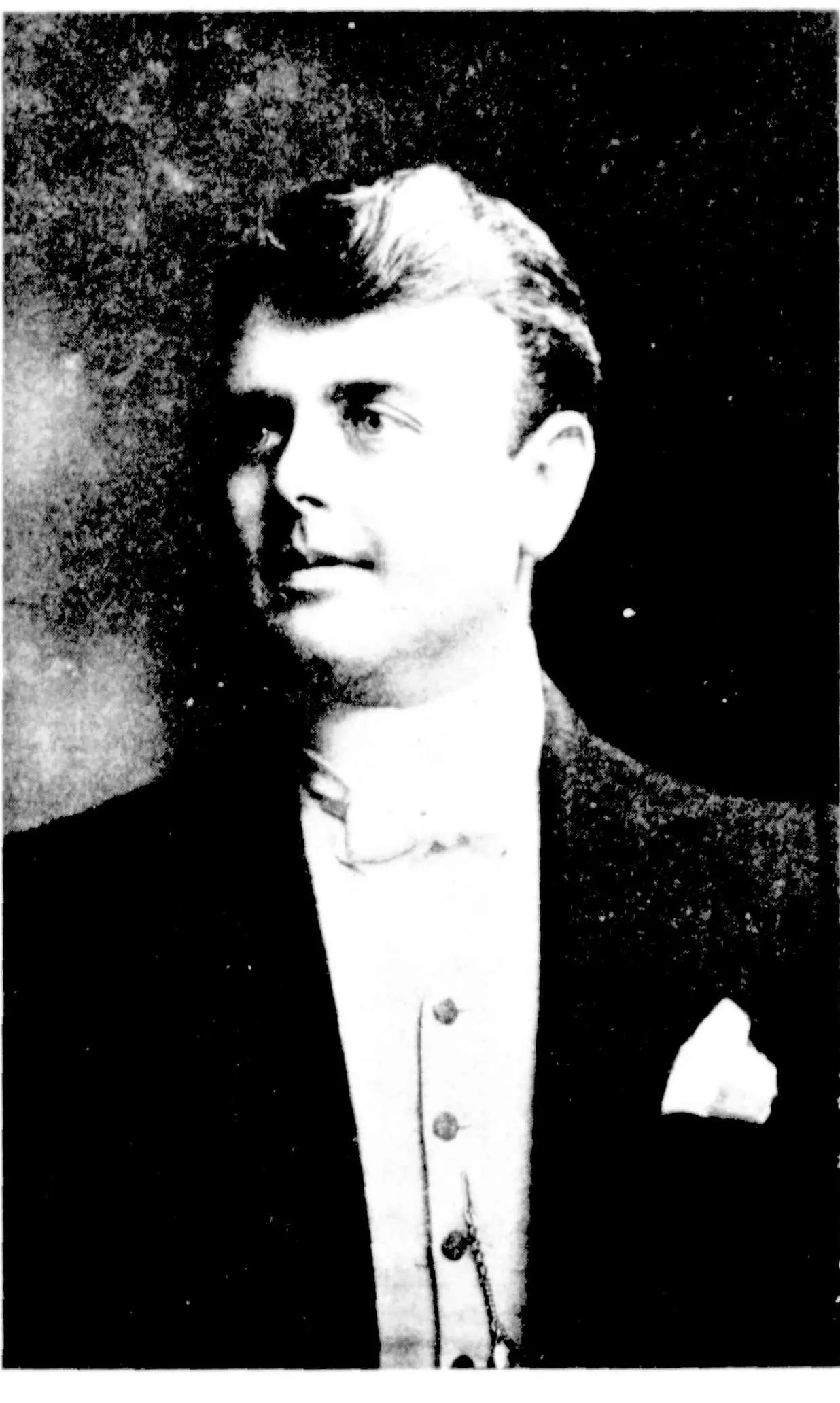
Harry Plimmer, head and shoulders, three-quarters to the left: fair wavy hair, evening dress, a white waistcoat and a handkerchief in his breast pocket.
Harry Plimmer, Australia’s first Holmes. Western Mail (Perth), 26 July 1902, page 24, via Trove
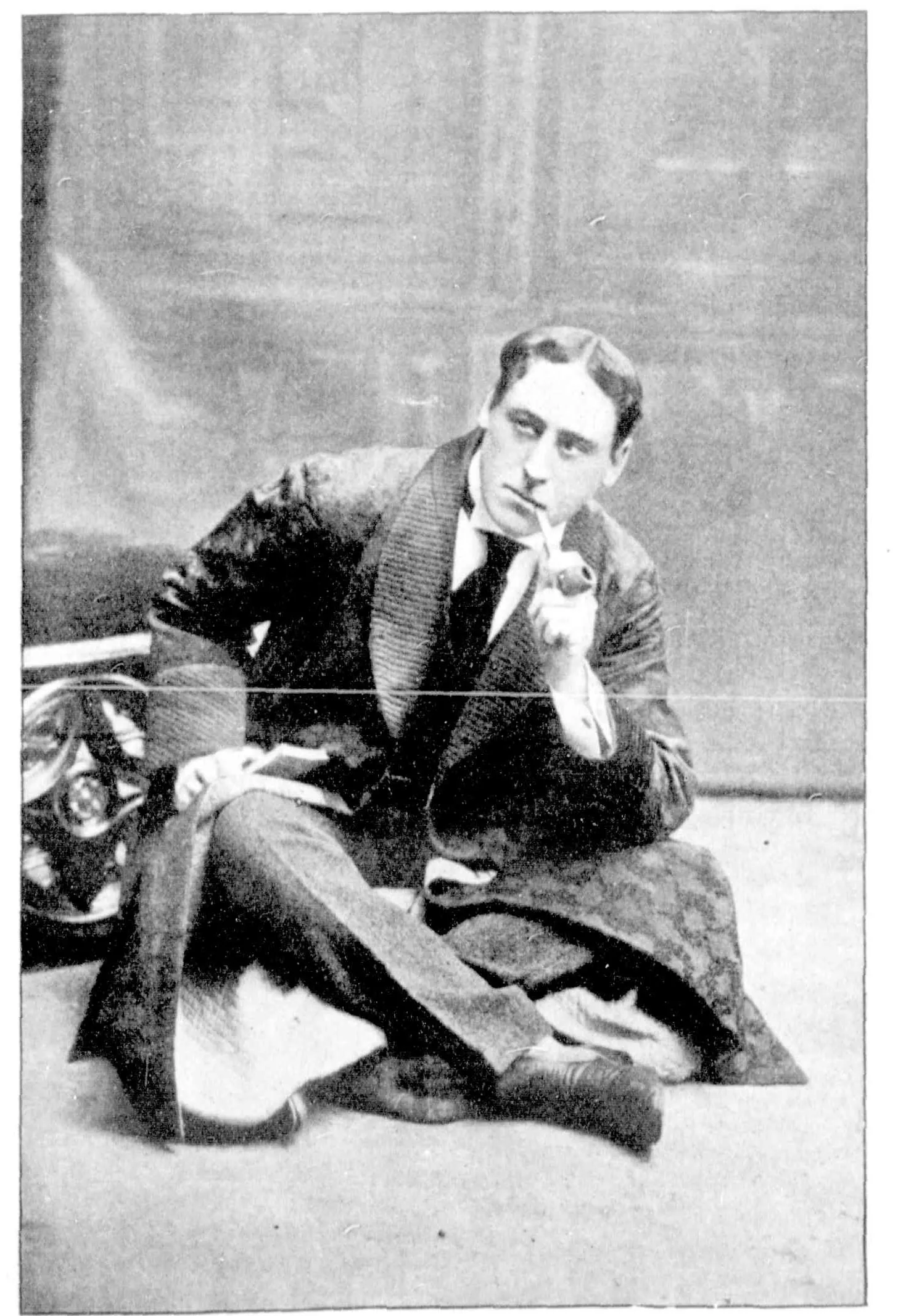
Cuyler Hastings as Holmes, sitting on the floor against a couch in a quilted dressing-gown over his suit, a curved pipe at his lips and a book on his knee.
Cuyler Hastings as Holmes, 1903. The Chronicle (Adelaide), 12 September 1903, page 44, via Trove

The houselights went out before each act and the scene appeared out of the dark. In the gas chamber at Stepney Holmes smashed the lamp with a chair, and Moriarty’s men followed the glow of his cigar to the window, where he had left it burning. The lamps cost the management one and sixpence a night.

“He has rarely occasion to raise his voice above a monotone, and he is most impressive when his delivery is most subdued.”

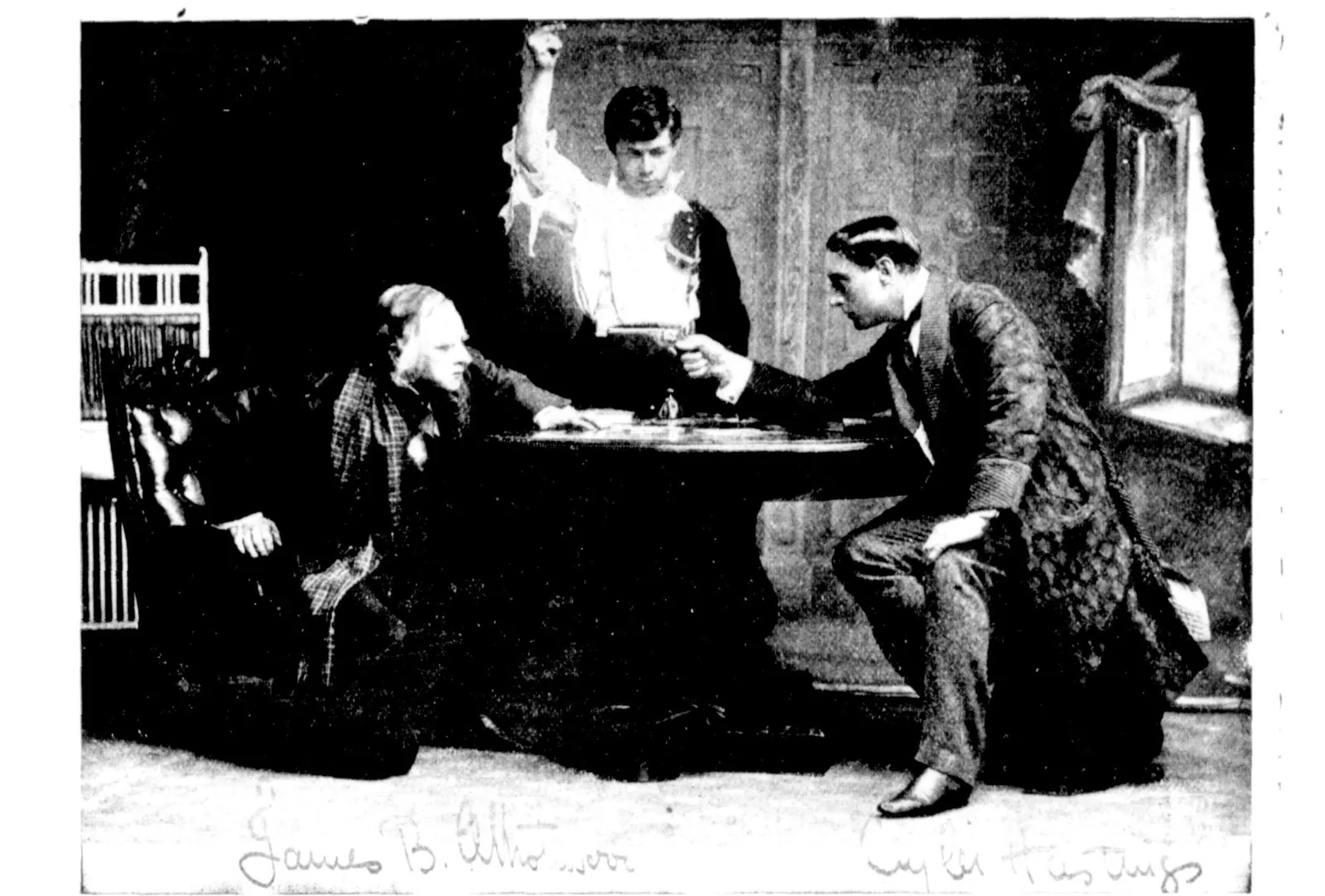
A stage photograph: Moriarty, seated at a table in a plaid shawl, faces Holmes, who leans across the table towards him, while Billy, behind them, raises his arm. Signed across the foot of the picture “James B. Atholwood” and “Cuyler Hastings”.
Act II: Atholwood’s Moriarty, Hastings’s Holmes and Billy, signed by the two men. Western Mail (Perth), 26 September 1903, page 30, via Trove
The first year, city by city
OpenedWhere
Perth, Theatre RoyalHarry Plimmer
Adelaide, Theatre RoyalHarry Plimmer
Melbourne, Her Majesty’sCuyler Hastings
Sydney, Theatre RoyalCuyler Hastings
Newcastle, Victoria TheatreCuyler Hastings
Hobart, Theatre RoyalCuyler Hastings
Dunedin, Princess’s TheatreCuyler Hastings
Brisbane, His Majesty’sCuyler Hastings
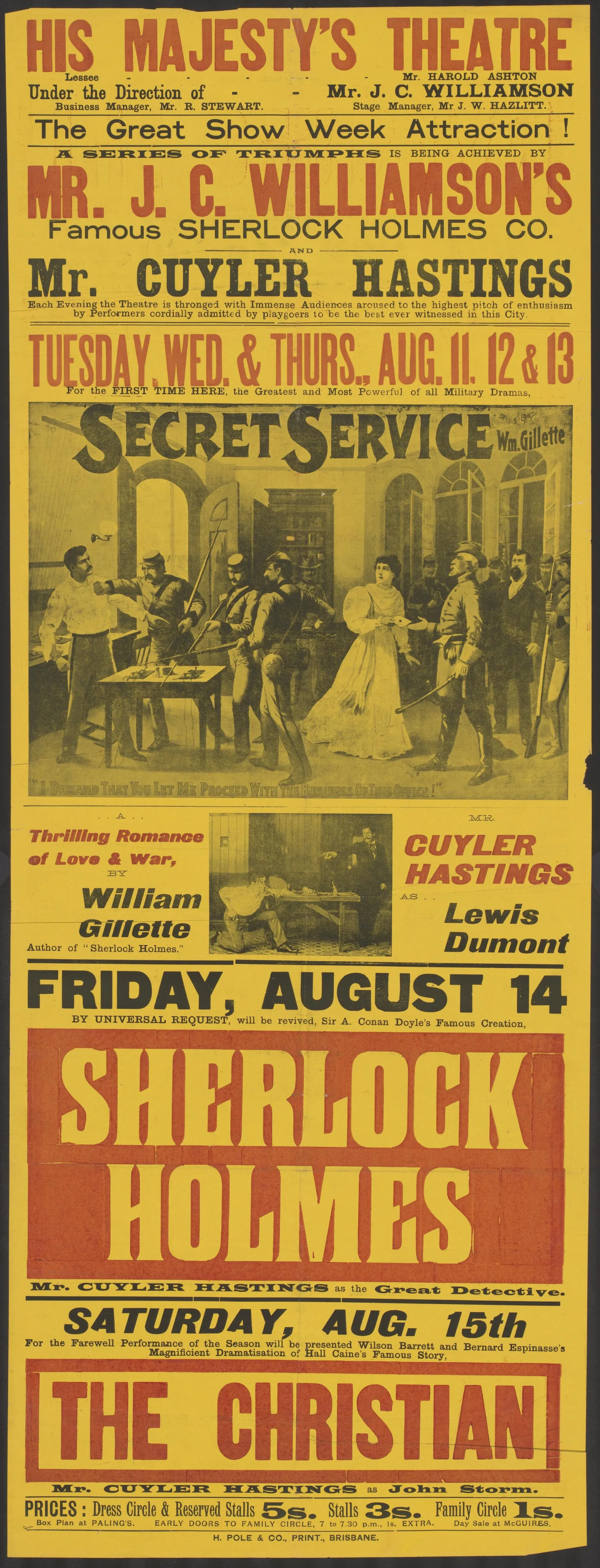
A tall poster printed in red and black on yellow paper: His Majesty’s Theatre, under the direction of Mr J. C. Williamson, the Great Show Week attraction, Mr J. C. Williamson’s famous Sherlock Holmes Co., Mr Cuyler Hastings. Secret Service on Tuesday, Wednesday and Thursday, August 11, 12 and 13; Friday, August 14, Sherlock Holmes in big red letters; Saturday, August 15, The Christian.
His Majesty’s, Brisbane, show week, August 1903: one more night of Sherlock Holmes “by universal request”. National Library of Australia

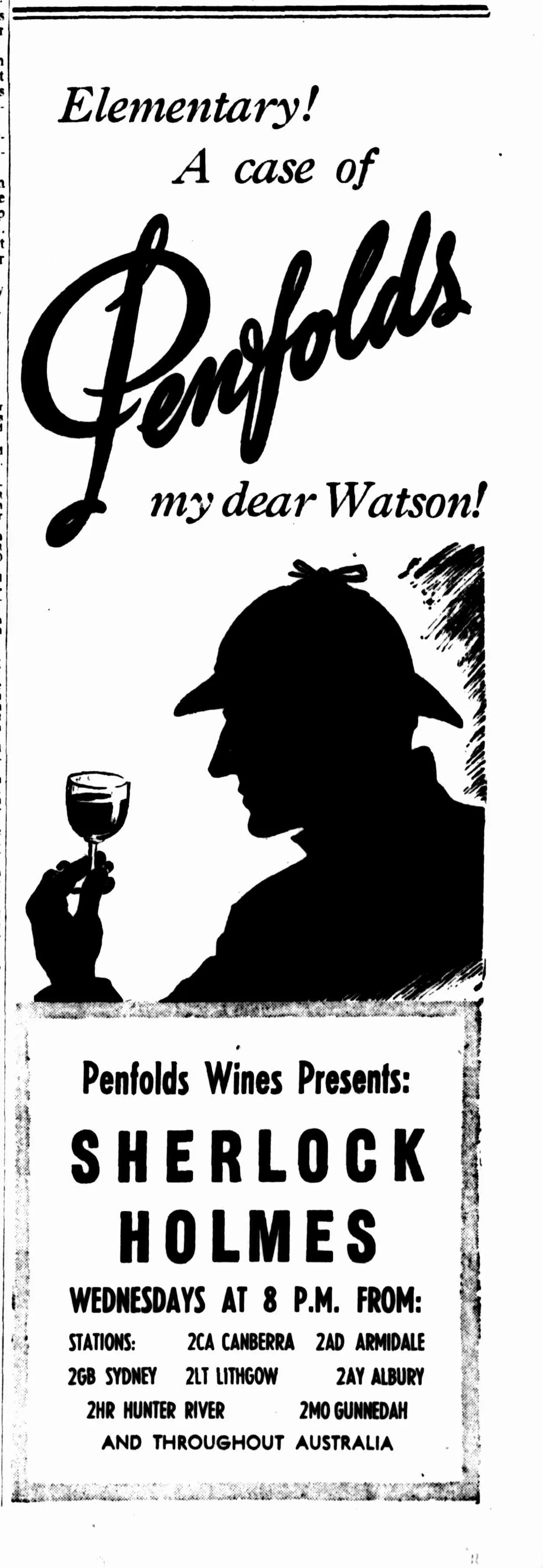
Australia’s own Holmes was on the radio. In November 1948 2GB secured the rights from the Conan Doyle estate, and from Wednesday 8 December half-hour plays went out live before a studio audience on a thirty-station hook-up, sponsored by Penfolds Wines, beginning with “The Speckled Band”. Moray Powell played Holmes and Peter Bathurst Watson.

Sources The West Australian, 26 July 1902; Daily News (Perth), 28 July 1902; The West Australian, 28 July 1902; The Referee, 15 October 1902; Table Talk, 25 September 1902; The Herald (Melbourne), 12 September 1902; The Register, 1 September 1904; The Gadfly, 13 June 1906; The Sun (Sydney), 16 November and 7 December 1948; Derham Groves, “Australia’s First and Second ‘Sherlock Holmes’”, 2011.

1920–21 Conan Doyle

Conan Doyle came in 1920, to talk about the dead

Arthur Conan Doyle reached Fremantle in the P&O Naldera on 17 September 1920: himself, his wife Jean, their sons Denis and Malcolm, their daughter Jean, Jakeman the maid and Major Wood, his secretary, seven in all. The Australian spiritualists had asked him to come. For five months he lectured on “Death and the Hereafter” and showed spirit photographs, in Adelaide, Melbourne, Geelong, Bendigo, Sydney, Brisbane and Perth and in four cities of New Zealand; by his own count, given in Sydney at the end of January, it came to twenty-five meetings and 50,000 people.

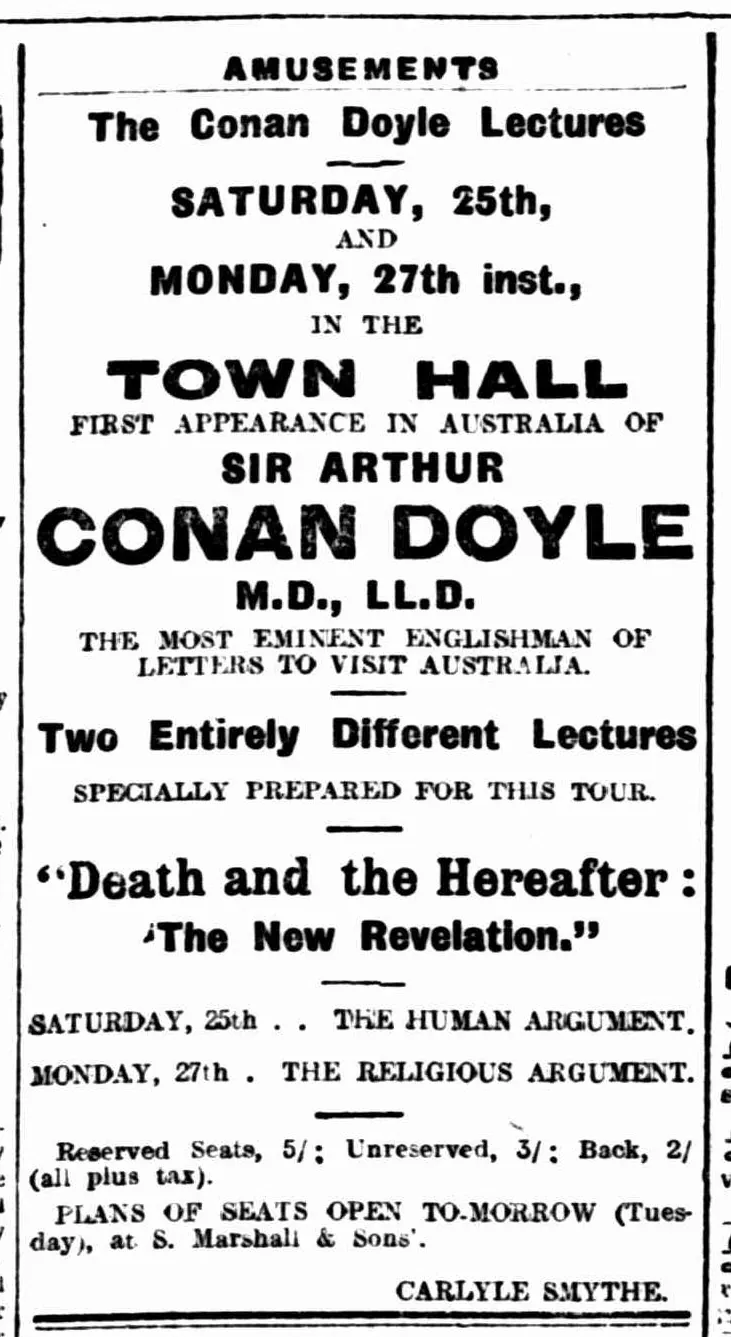
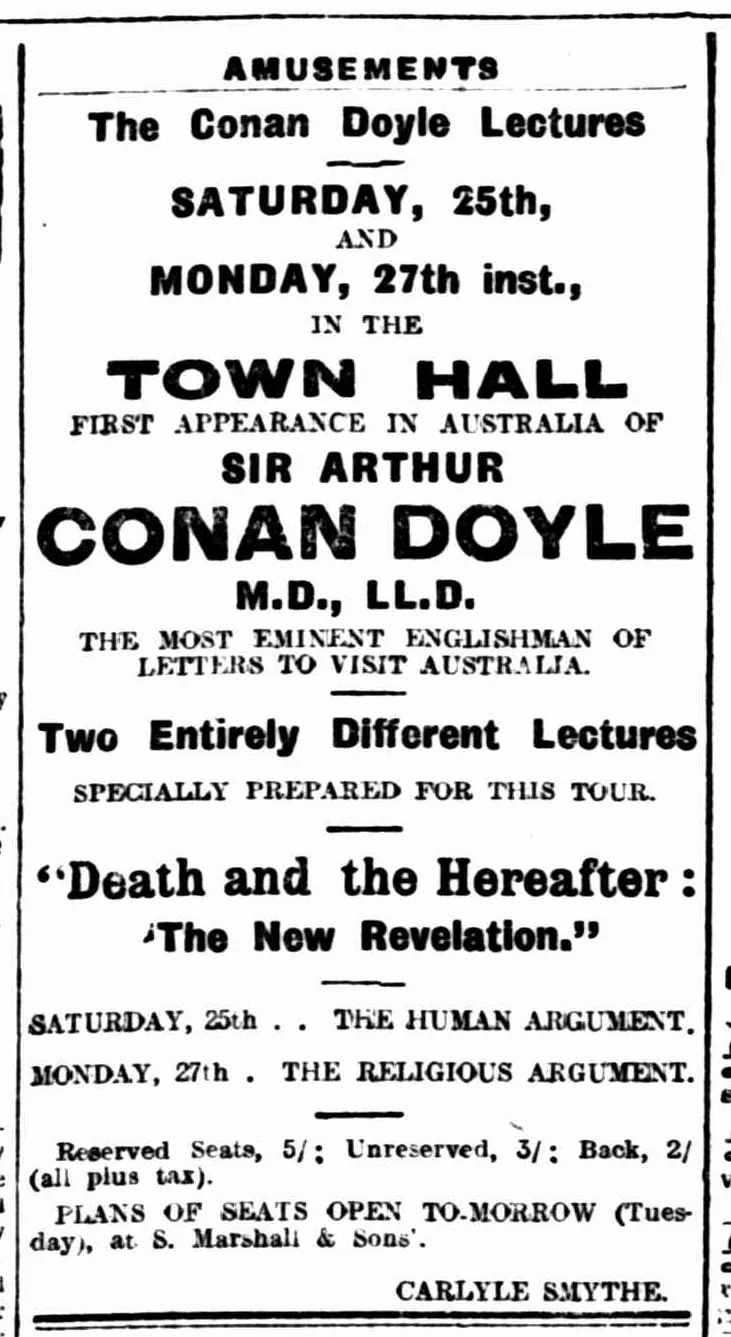
A single-column advertisement: The Conan Doyle Lectures, Saturday 25th and Monday 27th inst., in the Town Hall. First appearance in Australia of Sir Arthur Conan Doyle, M.D., LL.D., the most eminent Englishman of letters to visit Australia. Two entirely different lectures, “Death and the Hereafter: The New Revelation”: Saturday, the human argument; Monday, the religious argument. Reserved seats 5s., unreserved 3s., back 2s. Carlyle Smythe.
“First appearance in Australia”: Adelaide Town Hall, 25 and 27 September 1920. The Daily Herald (Adelaide), 20 September 1920, page 2, via Trove
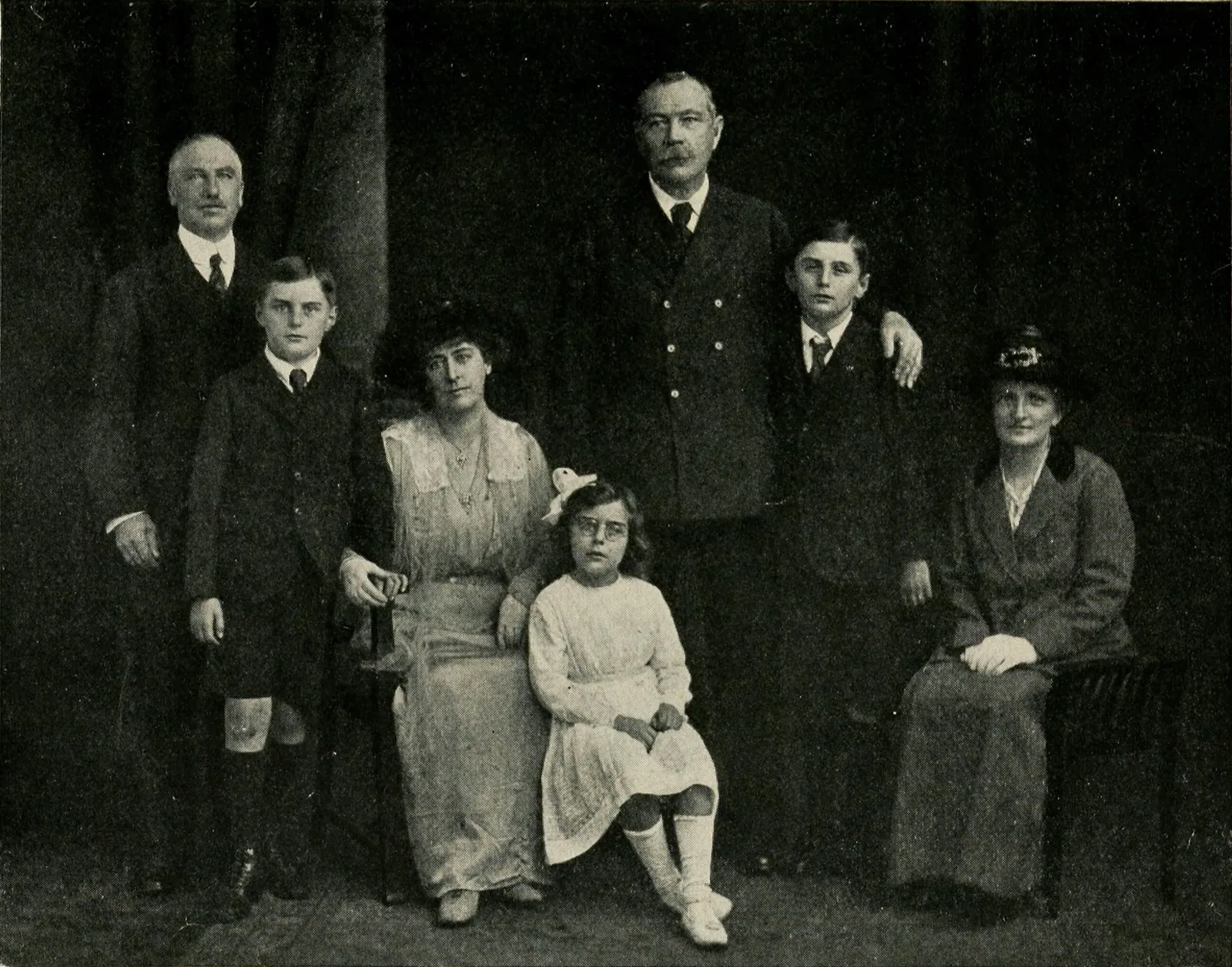
A studio group of seven against a dark curtain: Major Wood, standing, grey-haired; the two boys in dark suits; Lady Doyle seated in a pale lace dress with their small daughter; Conan Doyle; and Jakeman, the maid.
“The Wanderers”: the seven who came in the Naldera, photographed in Melbourne. Stirling, Melbourne; The Wanderings of a Spiritualist (1921), via Internet Archive
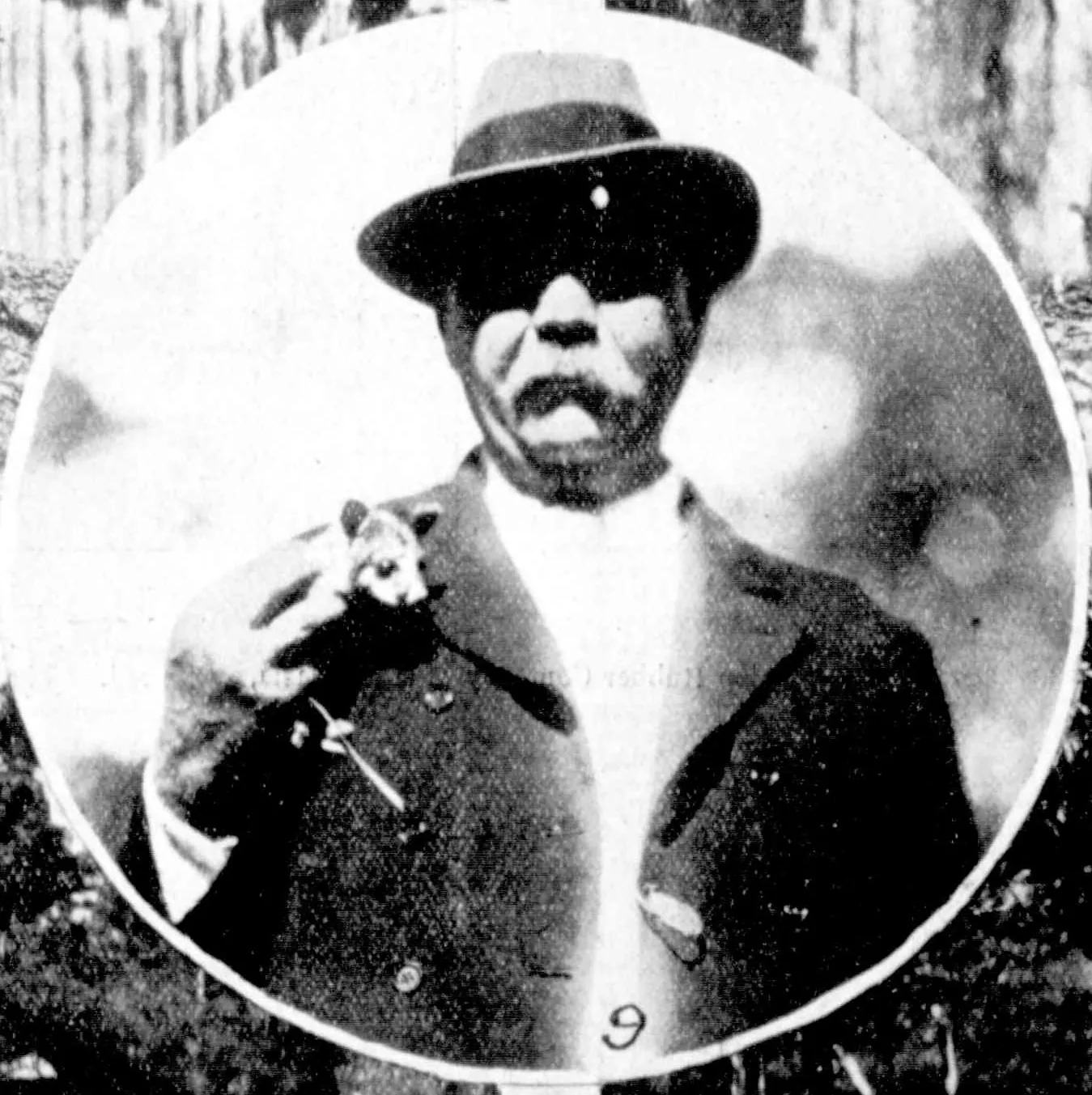
Conan Doyle in a soft felt hat and a dark coat, holding a baby possum up against his chest, in a round frame.
With a joey possum at T. P. Bellchambers’s sanctuary at Humbug Scrub, 29 September 1920. The Observer (Adelaide), 9 October 1920, page 25, photograph W. G. Smith, via Trove

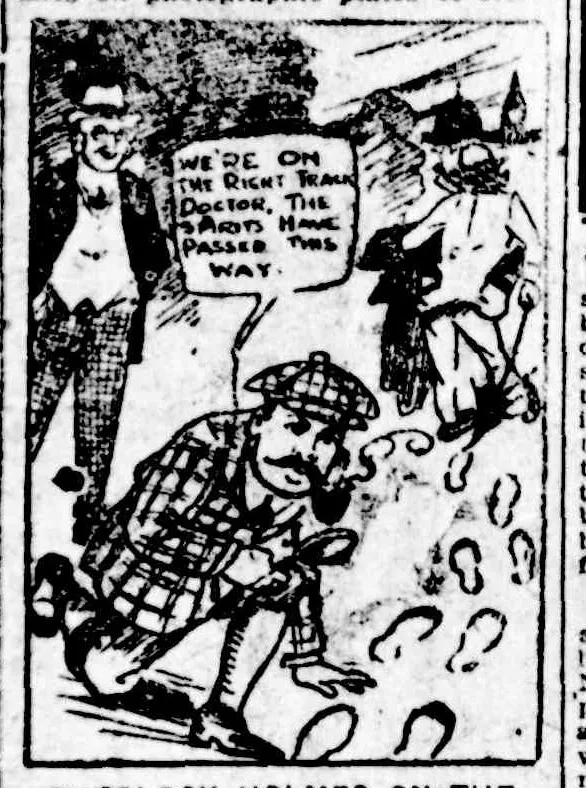
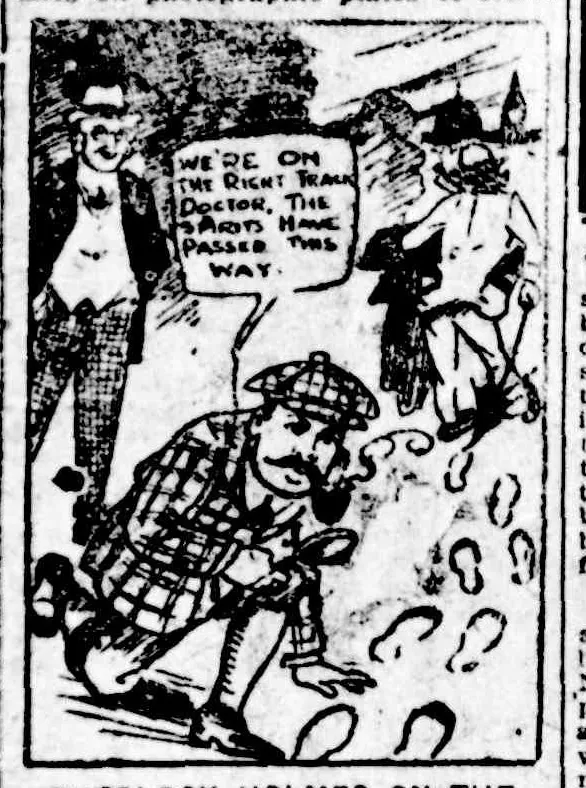
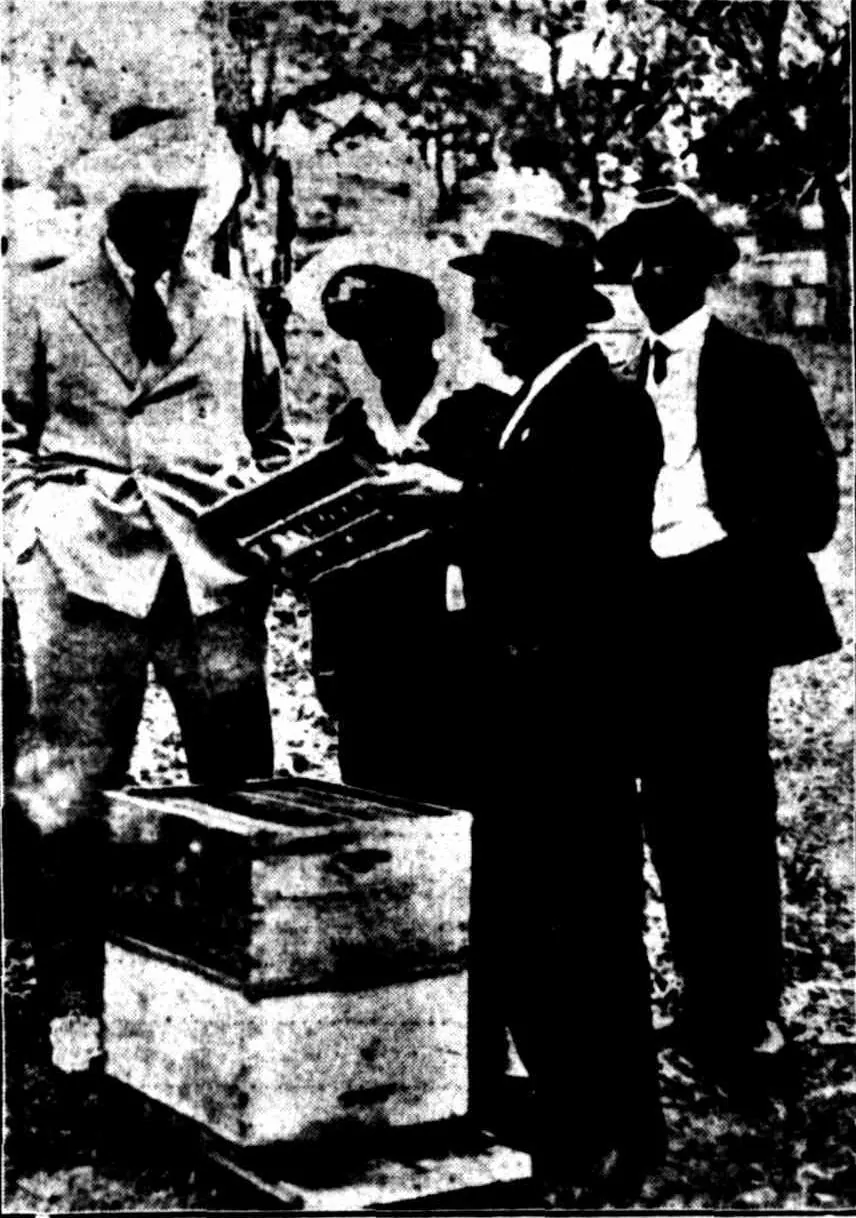
The Argus would not welcome him: “He represents a force which we believe to be purely evil.” Brisbane’s Truth drew him in a deerstalker on his hands and knees, following the spirits’ footprints. And everywhere they asked him about Holmes. When he reached Sydney a boy in the crowd at the station put it plainly: “The bloke that wrote Sherlock Holmes.” At the Millions Club lunch he told them that when he retired Holmes to a bee farm, two or three women wrote offering to keep house for him; in Brisbane the Daily Mail photographed him at an apiary, in a bee veil.

“I threw him over a cliff, and I believe that he is dead; but there is this important fact: No coroner has ever sat on him.”

A cartoon: a stout moustached man in a check deerstalker and check suit, Conan Doyle as Holmes, crawls along with a magnifying glass after a trail of footprints, pipe in mouth, saying “We’re on the right track, Doctor. The spirits have passed this way.” A grinning man in a top hat stands behind him.
“We’re on the right track, Doctor. The spirits have passed this way.” Truth (Brisbane), 9 January 1921, page 10, via Trove
Four people at an apiary among trees, two hive boxes in front: a man in a light suit, Lady Doyle in a veiled hat looking at a frame of comb held out to her, and Conan Doyle, tall, in a dark coat with a bee net over his face.
“‘Sherlock Holmes’ among the bees”: the Doyles at the Redbank Plains apiary, 13 January 1921. The Daily Mail (Brisbane), 15 January 1921, page 7, via Trove

Two lectures were booked for Ballarat, John Turner’s town; they were postponed, and then postponed indefinitely. Doyle saw it only from the Adelaide express, “the surface diggings of Ballarat on every side of the railway line”. He put the whole journey into The Wanderings of a Spiritualist, published in London in September 1921.

The tour, September 1920 to February 1921
WhereWhen
Fremantle and Pertharrived; no lecture17 September 1920
AdelaideTown Hall25, 27, 28 and 30 September
MelbourneThe Playhouse5, 7, 9, 11 and 16 October
GeelongMechanics’ Hall14 October
BendigoMasonic Hall18 October
Ballaratpostponed, then postponed indefinitely30 October
MelbourneTown Hall11 November
SydneyTown Hall15, 17, 20 and 27 November
New ZealandAuckland, Wellington, Christchurch, DunedinDecember
BrisbaneHis Majesty’s Theatre10, 11 and 13 January 1921
MelbourneTown Hall4 February
PerthHis Majesty’s Theatre, at lunch time; the ship sailed at three11 February

Sources Doyle, The Wanderings of a Spiritualist (1921), pp. 13, 22–23, 83, 247, 263; The Argus, 25 September 1920; Evening News (Sydney), 13 November 1920; The Sun (Sydney), 13 November 1920; The Sydney Morning Herald, 23 November 1920; Truth (Brisbane), 9 January 1921; The Ballarat Star, 21 October and 6 November 1920; The Argus, 14 September 1921.

1922–1954 The advertisements

Holmes sold cough cure, light globes, fences and petrol

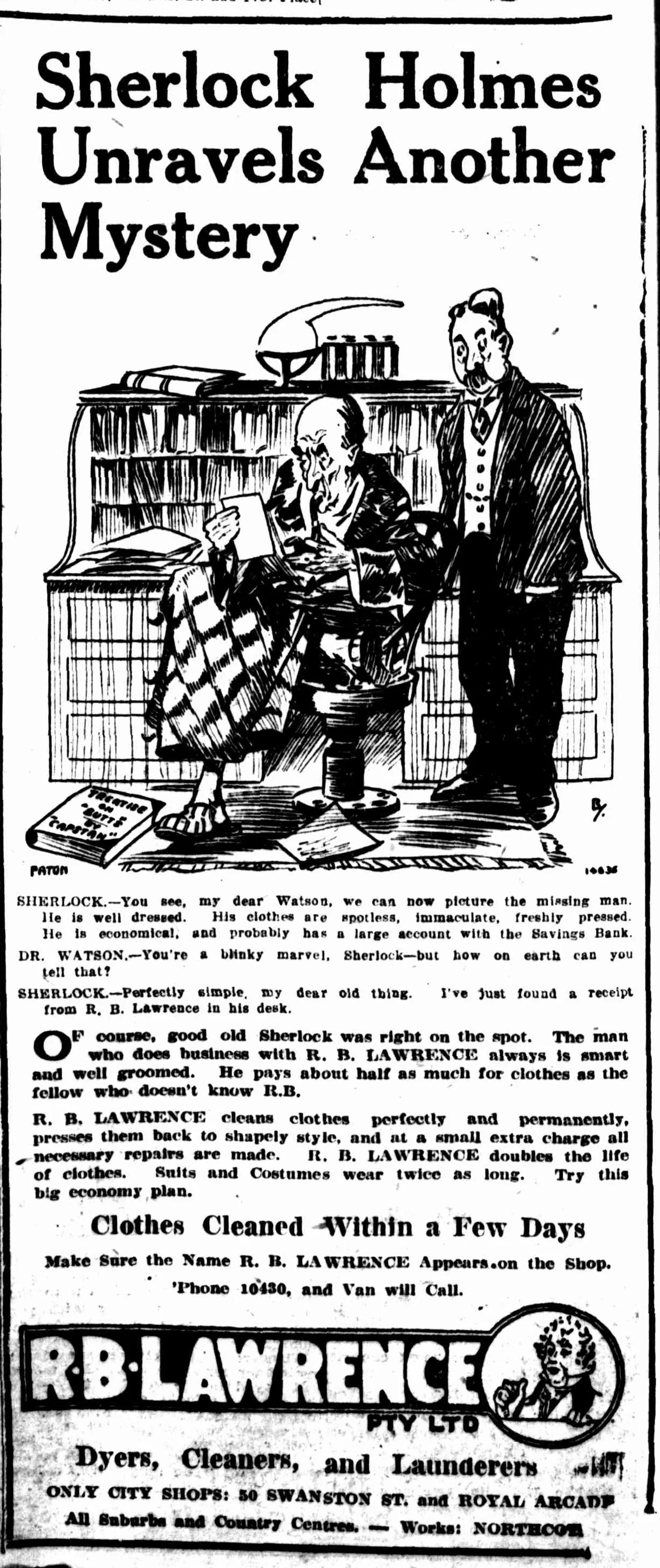
In 2009 Derham Groves posted twelve Australian newspaper advertisements that borrowed Holmes, from a cough cure in 1924 to a petrol in 1954. Every one of them is on Trove, and here they are from the newspapers’ own pages, with the earliest pictorial one found since, a Melbourne dry cleaner’s of 1922.

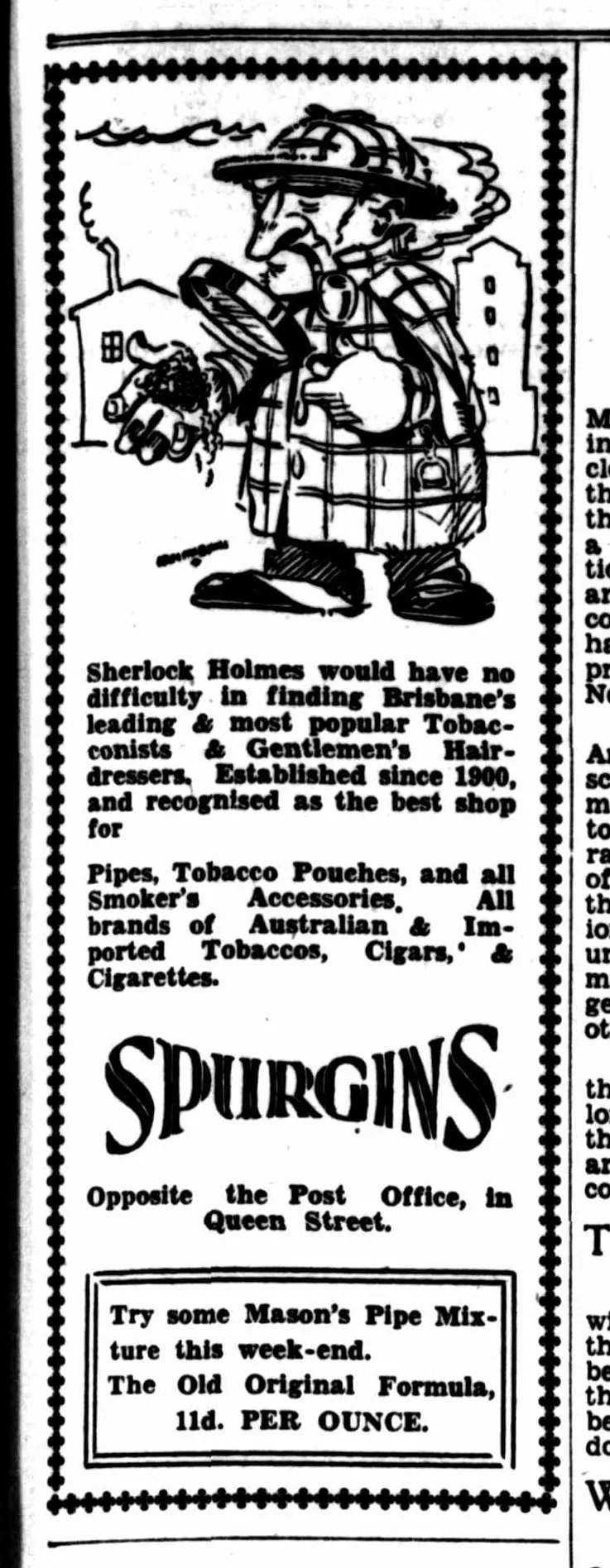
Most were national campaigns, printed in papers all over the country within a week or two: Woods’ Great Peppermint Cure, Crompton lamps, Texaco, the coal economy drive of 1944 and C.O.R. petrol. Cyclone fences ran theirs in Melbourne and Adelaide, the Sydney County Council in Sydney. One was a single shop: Spurgins, tobacconists and gentlemen’s hairdressers, opposite the Post Office in Queen Street, Brisbane.

An advertisement: “Sherlock Holmes Unravels Another Mystery”, over a pen drawing of an elderly Holmes in a dressing gown reading a slip of paper at his desk, Watson beside him: “You see, my dear Watson, we can now picture the missing man. He is well dressed … I’ve just found a receipt from R. B. Lawrence in his desk.”
R. B. Lawrence, dry cleaners: “Sherlock Holmes Unravels Another Mystery”. The Herald (Melbourne), 24 January 1922, page 2, via Trove
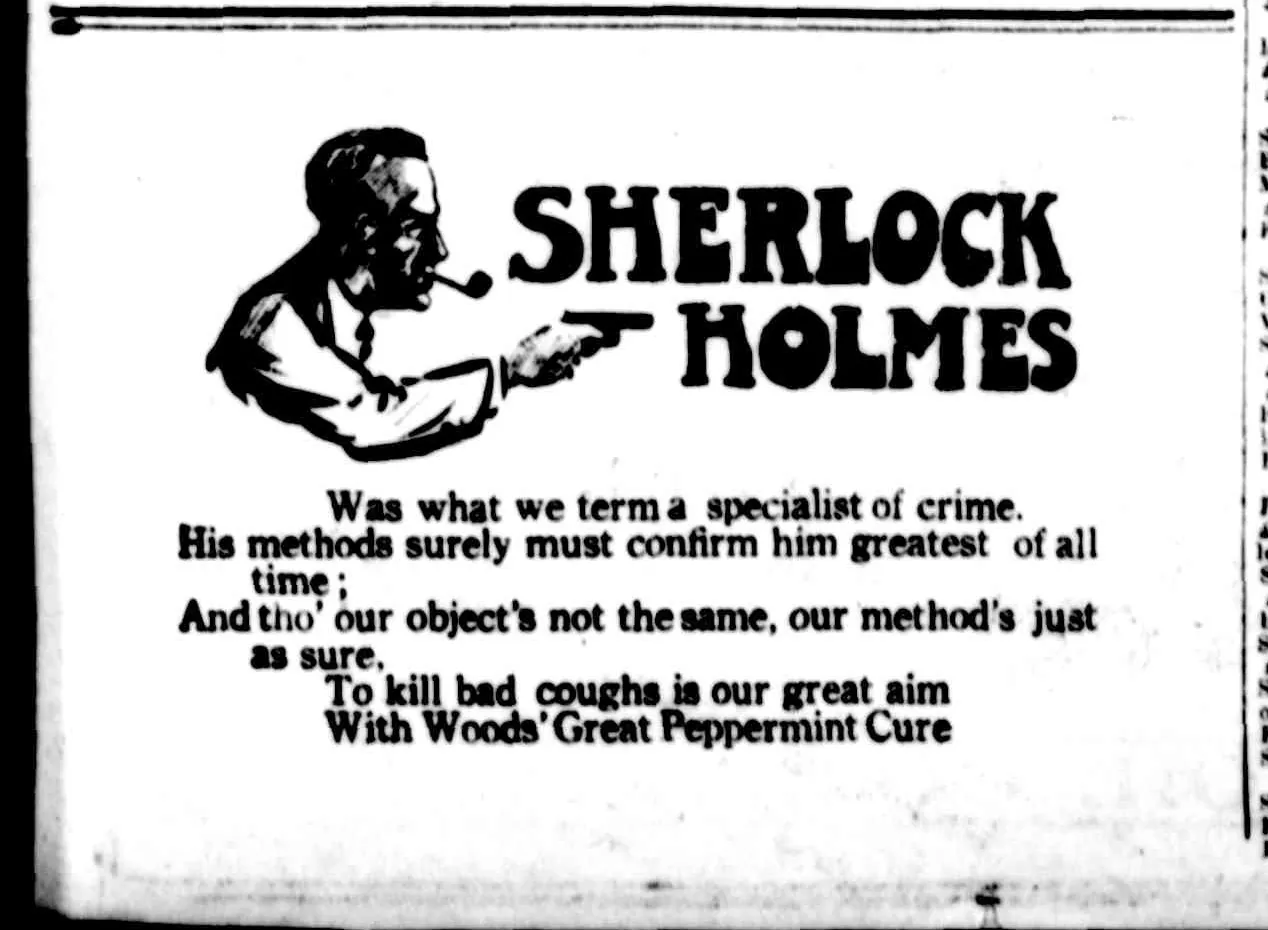
A small advertisement: a drawing of a sleek-haired Holmes with a pipe, pointing a pistol, beside the words “Sherlock Holmes / Was what we term a specialist of crime. / His methods surely must confirm him greatest of all time; / And tho’ our object’s not the same, our method’s just as sure. / To kill bad coughs is our great aim / With Woods’ Great Peppermint Cure.”
Woods’ Great Peppermint Cure: “To kill bad coughs is our great aim”. The Argus, 15 May 1924, page 5, via Trove
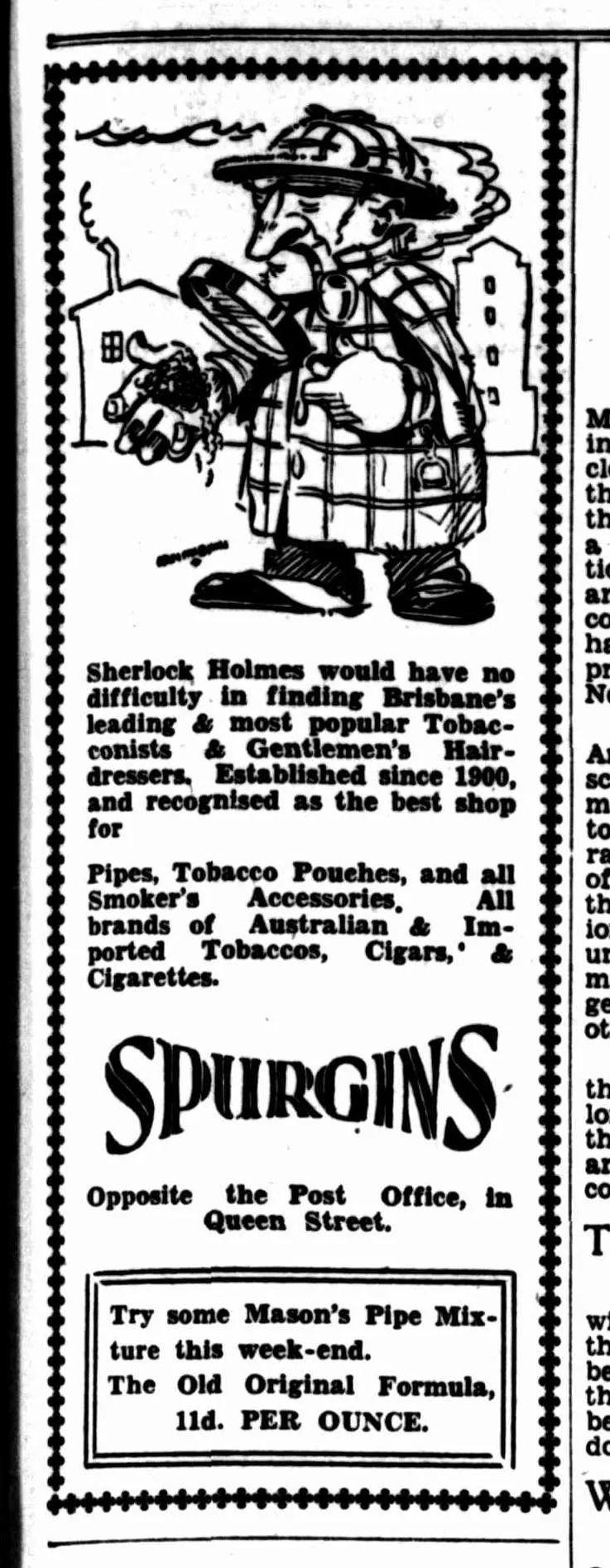
A small advertisement in a dotted border: a cartoon Holmes in a check deerstalker and cape, smoking, studies a pipe through his magnifying glass. “Sherlock Holmes would have no difficulty in finding Brisbane’s leading & most popular Tobacconists & Gentlemen’s Hairdressers … Spurgins, opposite the Post Office, in Queen Street.”
Spurgins, tobacconists and gentlemen’s hairdressers, Queen Street, Brisbane. The Courier-Mail, 25 November 1933, page 9, via Trove
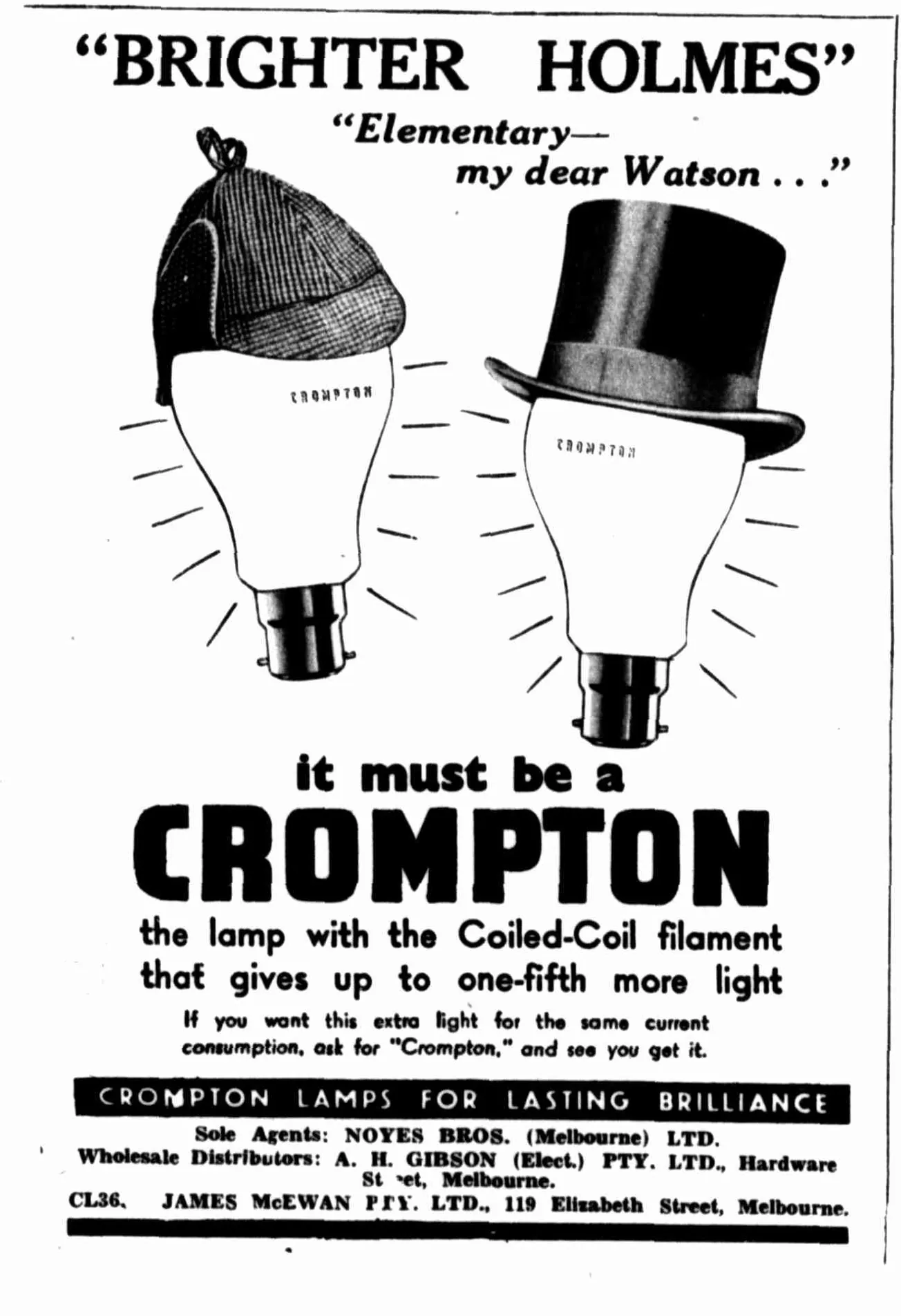
An advertisement: two electric light globes, one wearing a deerstalker and one a top hat, under “Brighter Holmes”, “Elementary—my dear Watson …”, “it must be a Crompton, the lamp with the coiled-coil filament that gives up to one-fifth more light”.
Crompton lamps: “Brighter Holmes”. The Argus, 11 June 1938, page 12, via Trove
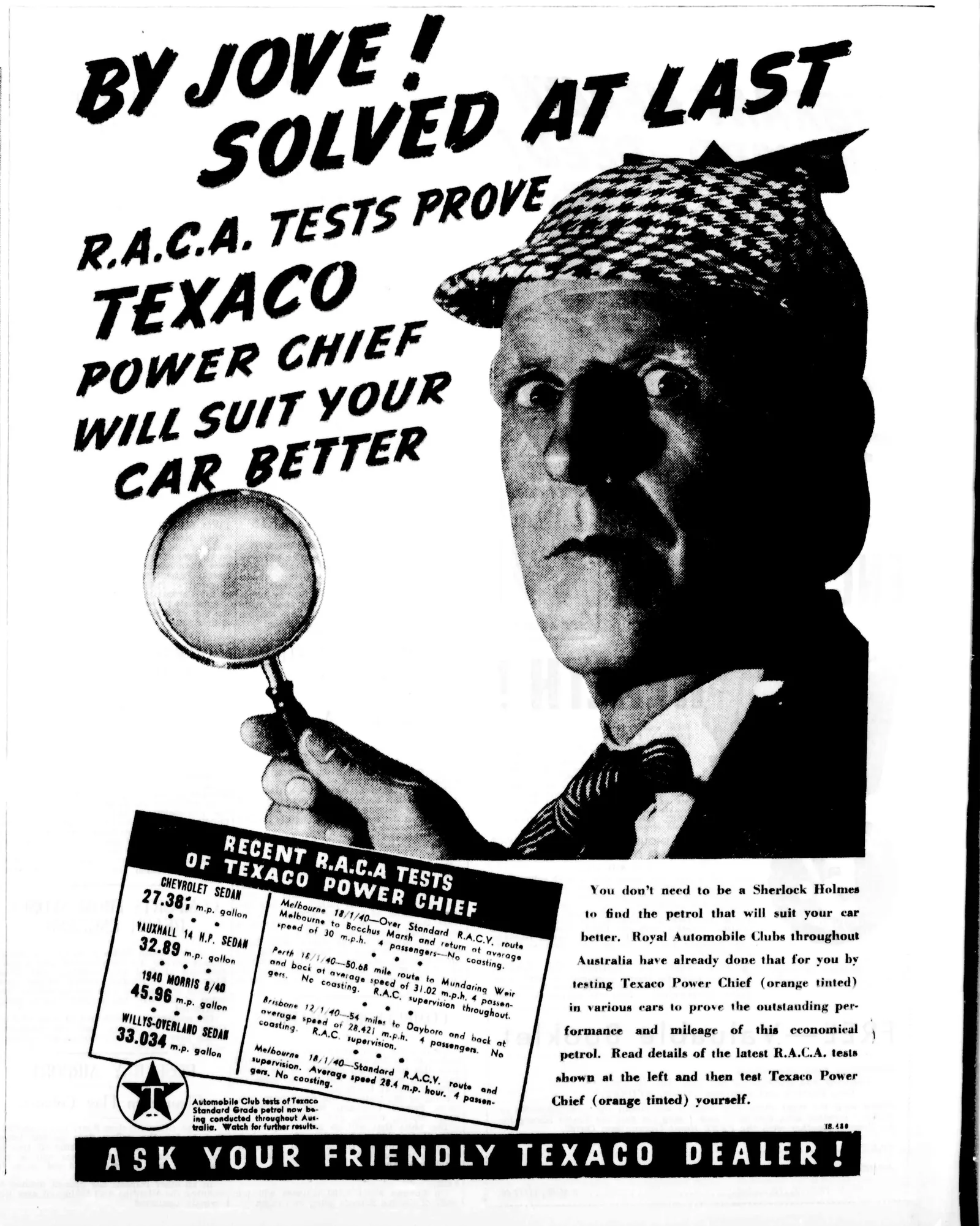
An advertisement built round a photograph of a goggle-eyed man in a check deerstalker holding up a magnifying glass: “By Jove! Solved at last. R.A.C.A. tests prove Texaco Power Chief will suit your car better.”
Texaco Power Chief: “You don’t need to be a Sherlock Holmes to find the petrol that will suit your car better.” The Sydney Morning Herald, 31 January 1940, page 16, via Trove
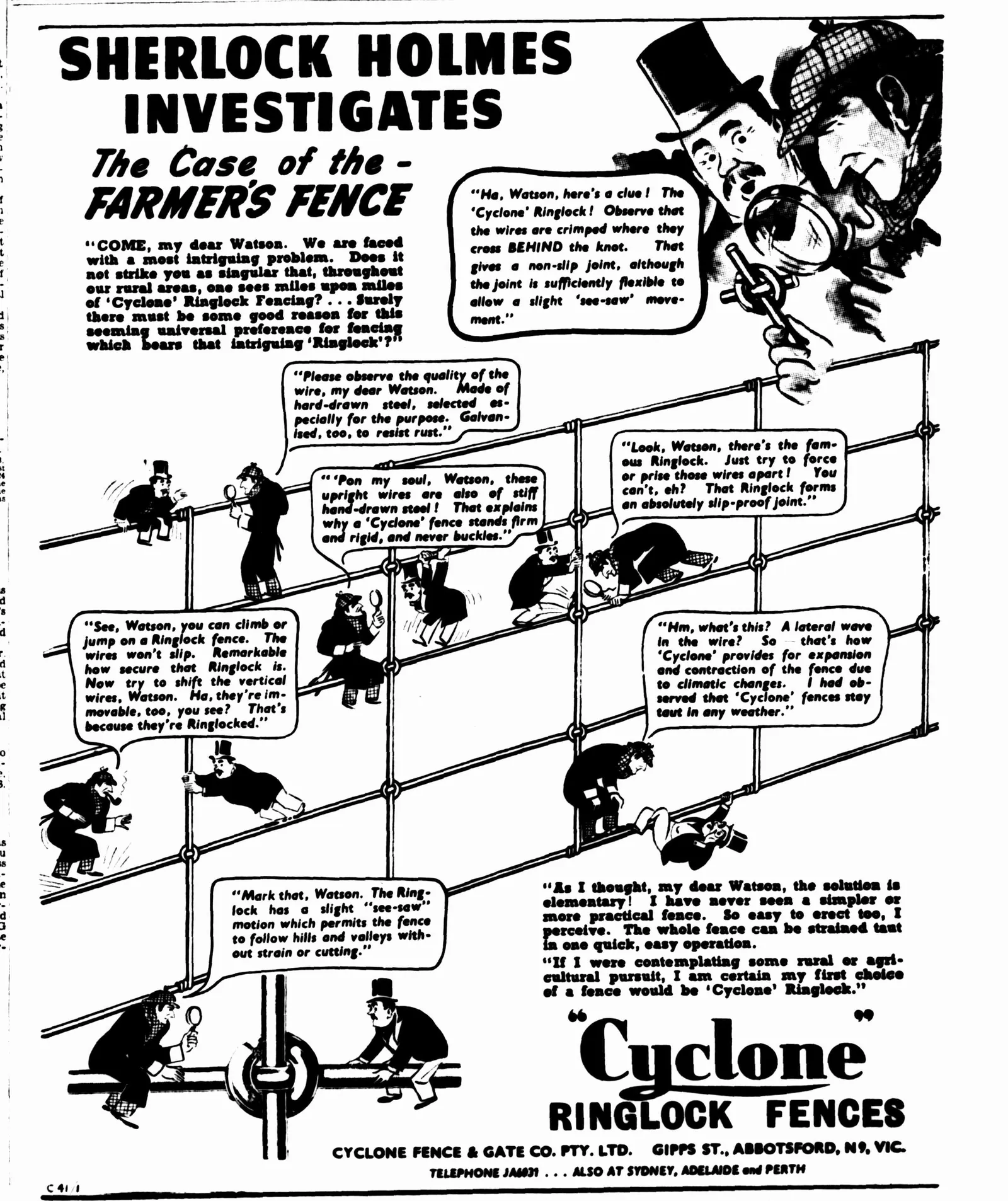
A comic-strip advertisement: “Sherlock Holmes investigates the case of the farmer’s fence.” Holmes in a deerstalker with his magnifying glass and Watson in a top hat crawl along a wire fence through seven panels: “Ha, Watson, here’s a clue! The ‘Cyclone’ Ringlock!” and at last, “As I thought, my dear Watson, the solution is elementary!” Cyclone Fence and Gate Co., Gipps Street, Abbotsford.
Cyclone Ringlock fences, Abbotsford: “The Case of the Farmer’s Fence”. The Argus, 3 February 1941, page 3, via Trove
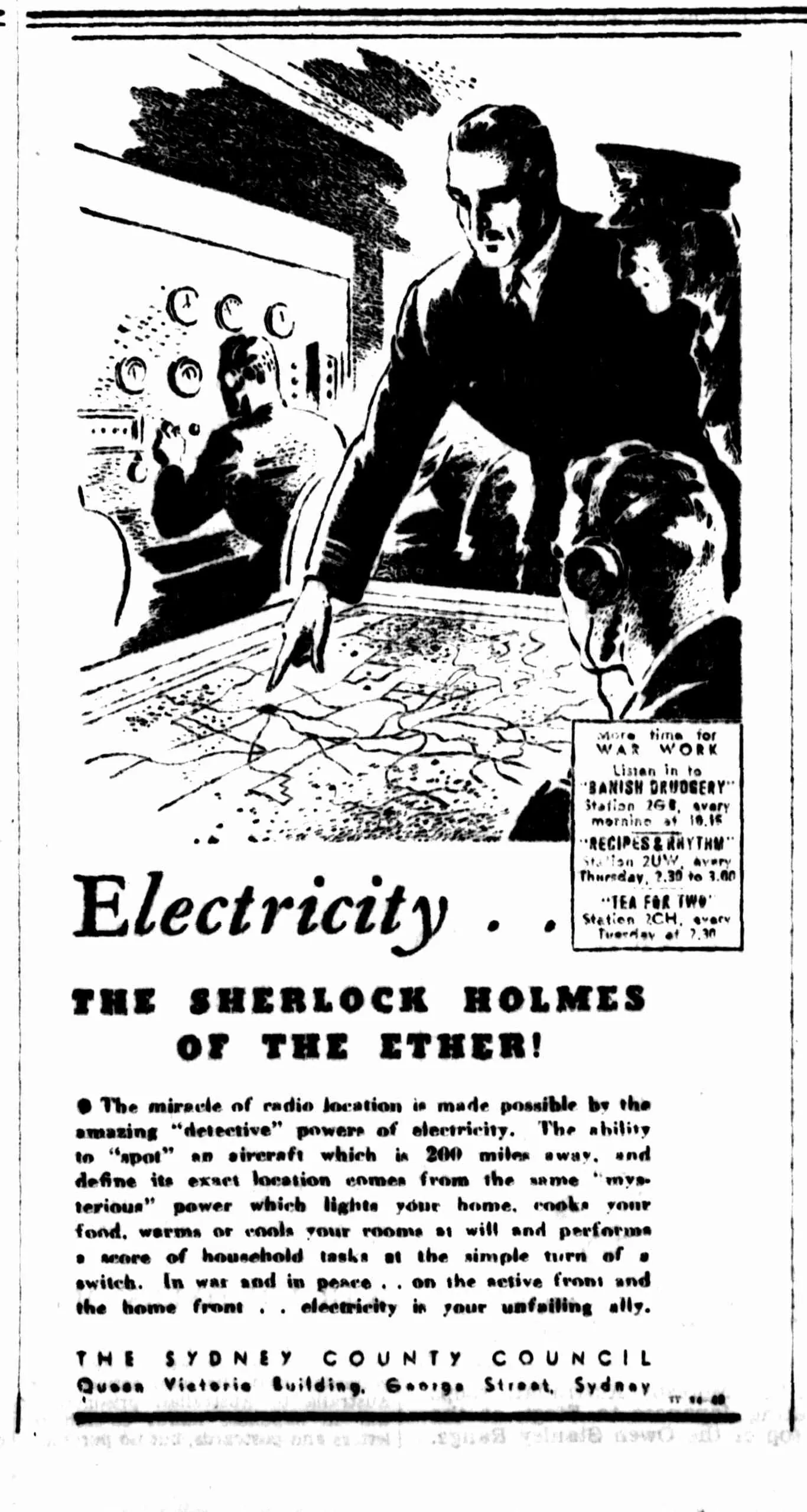
An advertisement: a drawing of men at a radar plotting table, then “Electricity . . the Sherlock Holmes of the ether!” and a column on “the miracle of radio location”, signed by the Sydney County Council, Queen Victoria Building, George Street.
The Sydney County Council: “Electricity . . the Sherlock Holmes of the ether!” The Sydney Morning Herald, 5 October 1942, page 3, via Trove
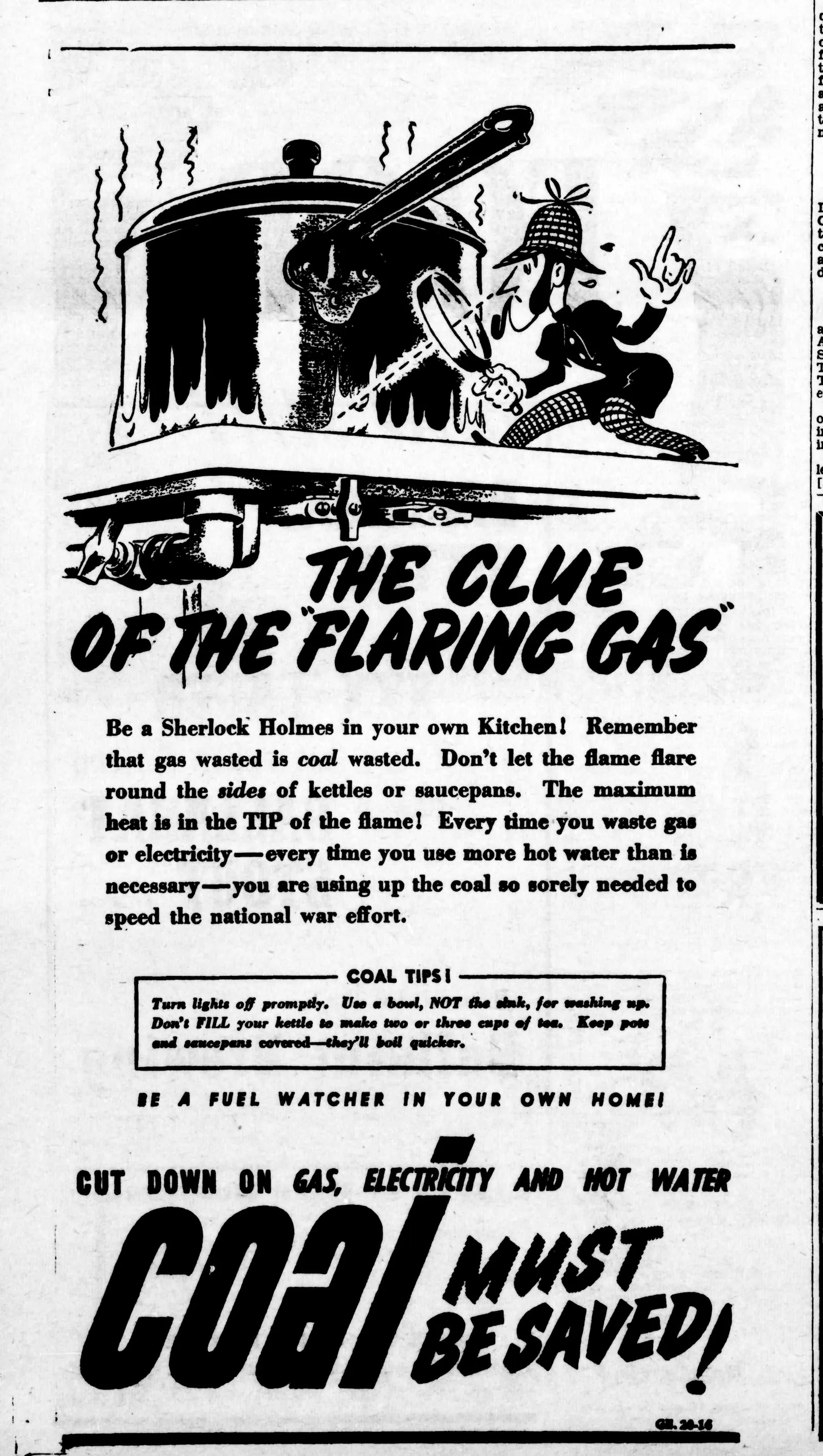
An advertisement: a cartoon Holmes in a deerstalker peers through his magnifying glass at a saucepan on a gas ring. “The clue of the ‘flaring gas’. Be a Sherlock Holmes in your own kitchen! Remember that gas wasted is coal wasted.” Coal tips, and “coal must be saved!”
The Commonwealth Coal Commission: “Be a Sherlock Holmes in your own Kitchen!” The Argus, 24 May 1944, page 4, via Trove
A tall one-column advertisement: “Elementary! A case of Penfolds my dear Watson!” over a black silhouette of Holmes in a deerstalker raising a glass of wine, and a box: “Penfolds Wines Presents: Sherlock Holmes, Wednesdays at 8 p.m.”, on 2CA Canberra, 2AD Armidale, 2GB Sydney, 2LT Lithgow, 2AY Albury, 2HR Hunter River, 2MO Gunnedah “and throughout Australia”.
Penfolds Wines present Sherlock Holmes on the radio, Wednesdays at 8. The Sydney Morning Herald, 11 December 1948, page 9, via Trove
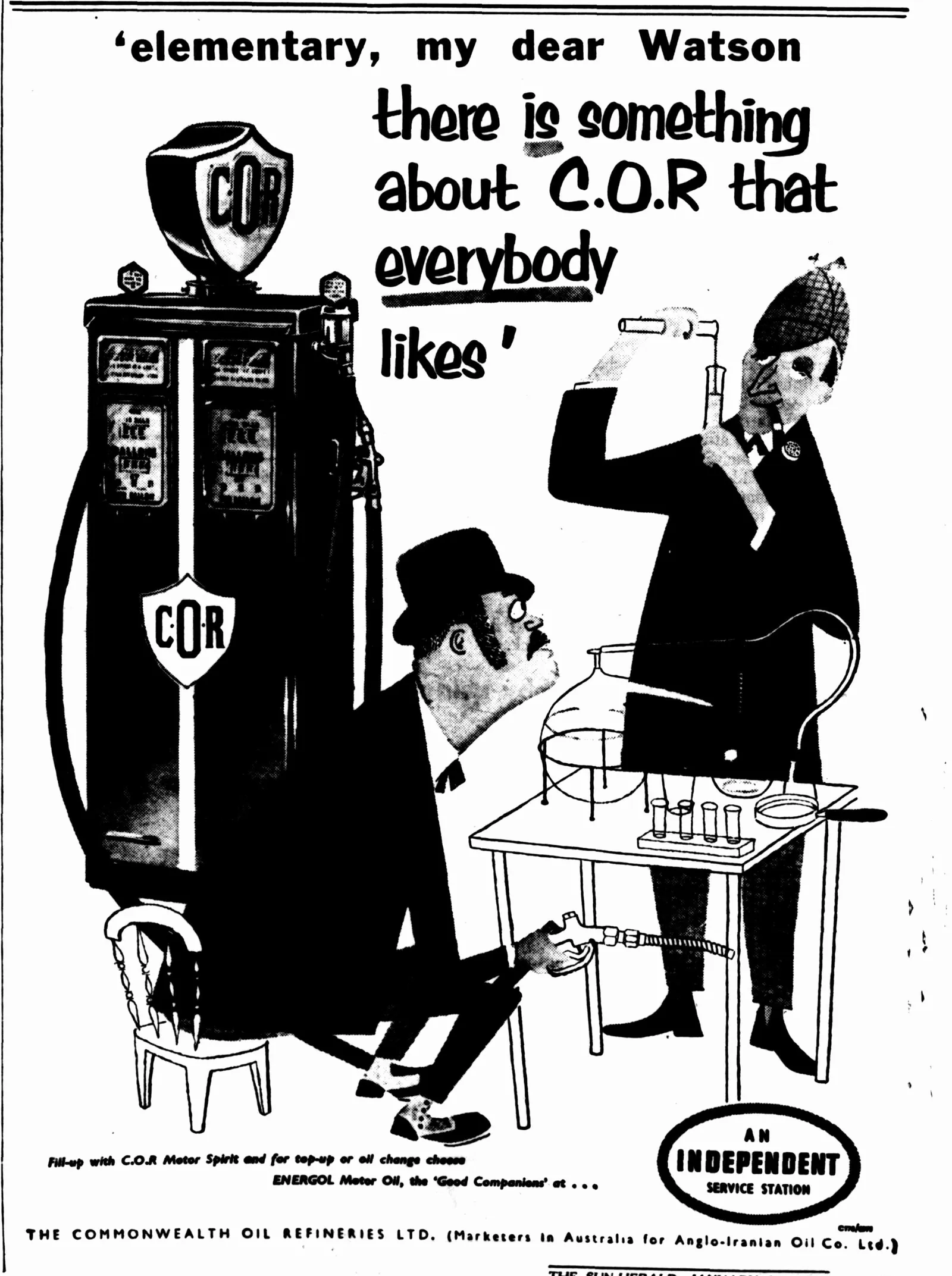
A cartoon advertisement: a tall, thin Holmes in a deerstalker pours from a test tube while a bowler-hatted Watson kneels to fill laboratory glassware from a C.O.R. petrol pump: “Elementary, my dear Watson, there is something about C.O.R. that everybody likes.”
C.O.R. petrol, the first of four: “there is something about C.O.R that everybody likes”. The Sun-Herald, 31 January 1954, page 49, via Trove
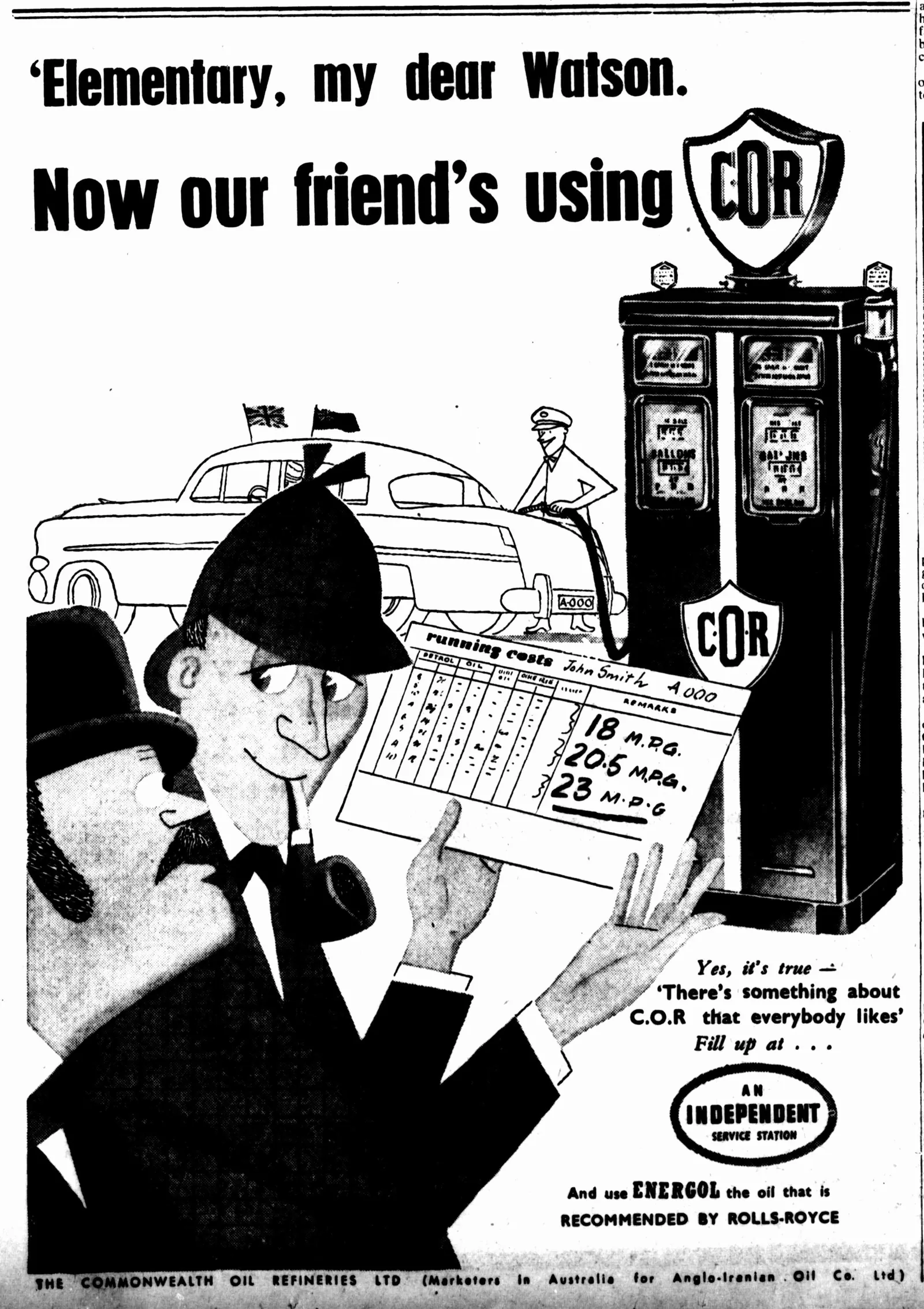
A cartoon advertisement: a pipe-smoking Holmes in a deerstalker holds up a running-costs card showing 18, 20.5 and 23 miles per gallon, Watson’s bowler at the edge, a car being filled behind: “Elementary, my dear Watson. Now our friend’s using C.O.R.”
C.O.R.: “Now our friend’s using C.O.R.” The Sydney Morning Herald, 20 March 1954, page 6, via Trove
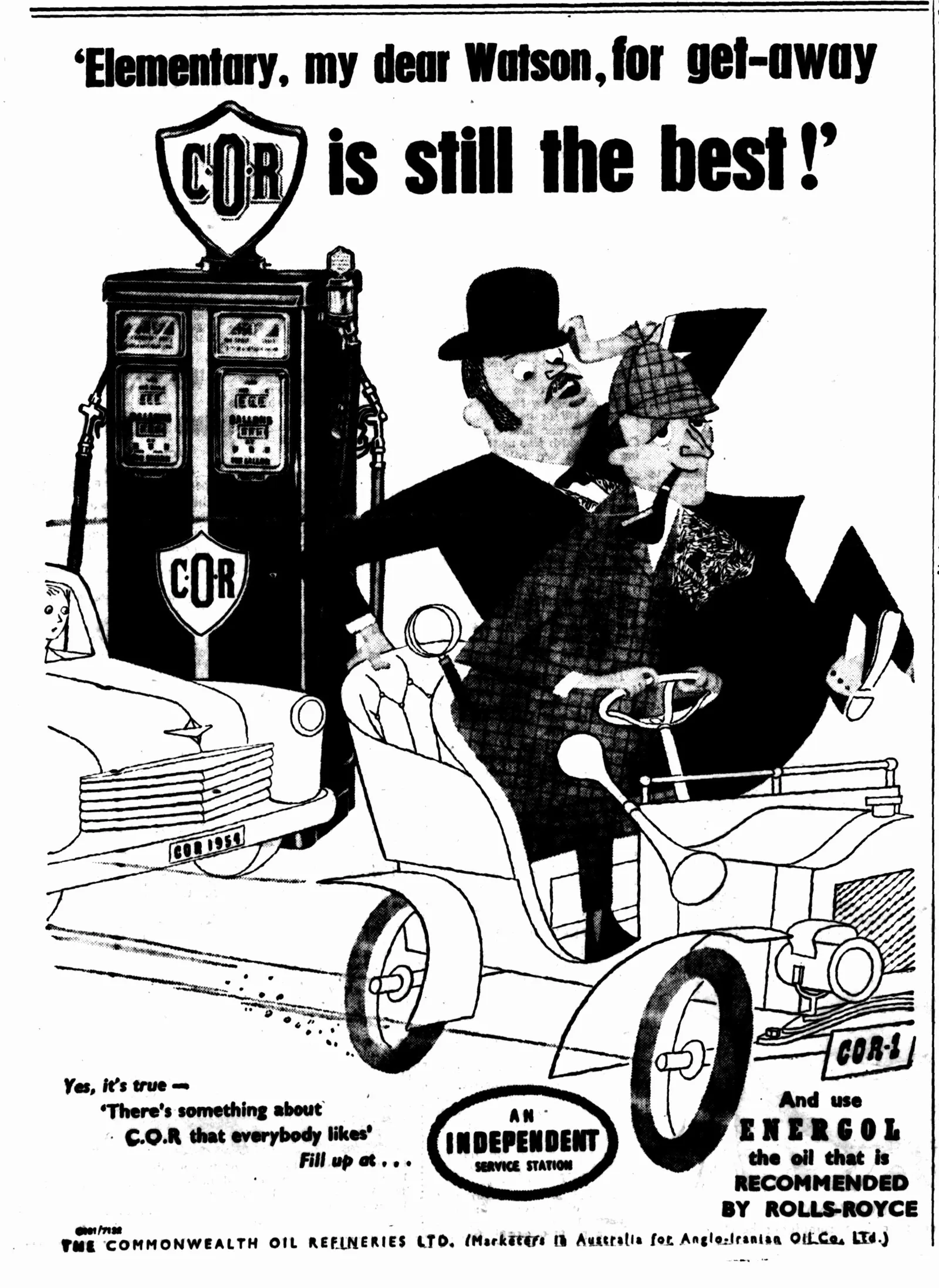
A cartoon advertisement: Holmes and Watson drive a veteran car plated COR-1 past a C.O.R. pump: “Elementary, my dear Watson, for get-away C.O.R. is still the best!”
C.O.R.: “for get-away C.O.R. is still the best!” The Sun-Herald, 4 April 1954, page 58, via Trove
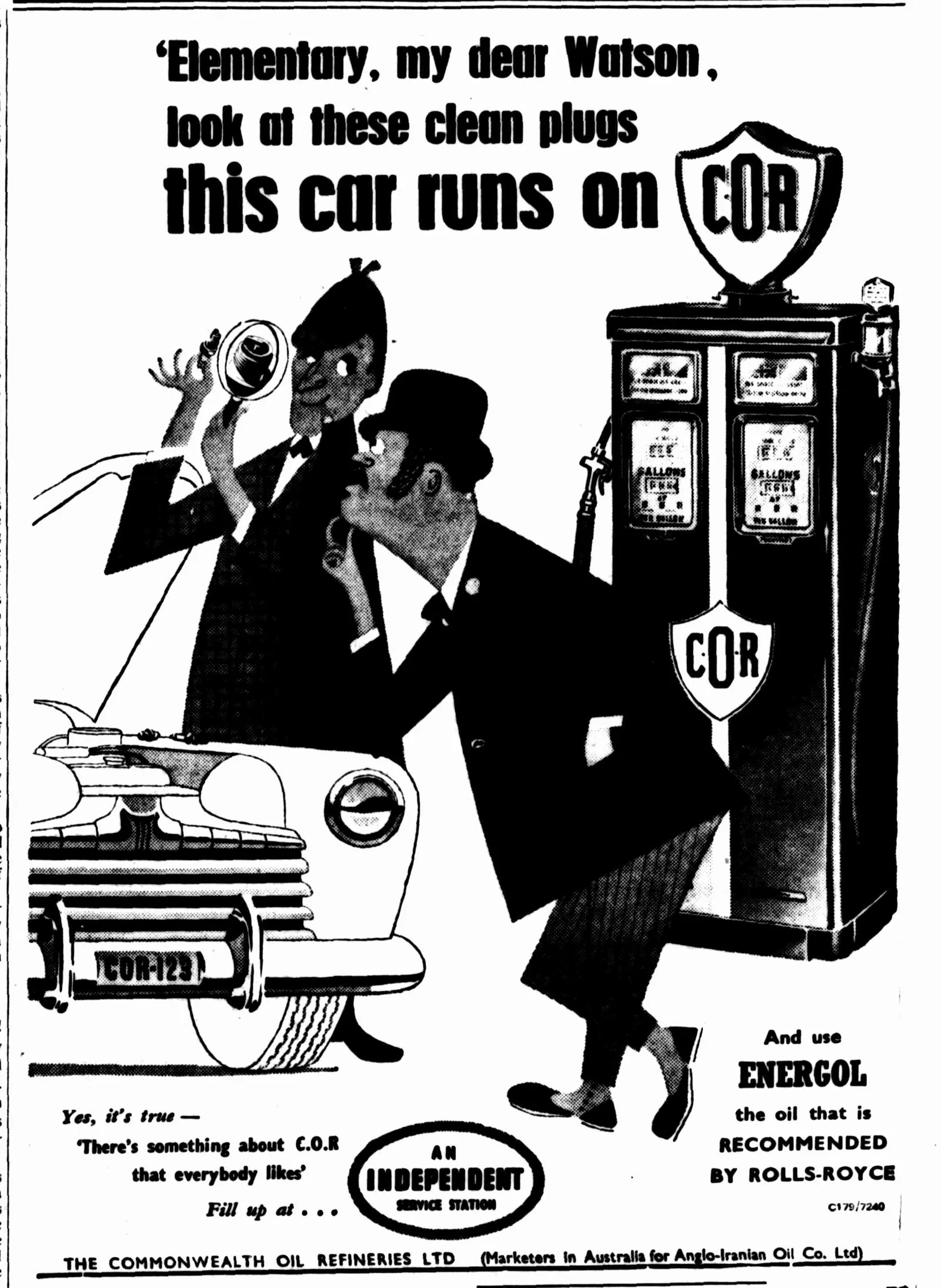
A cartoon advertisement: Holmes holds a spark plug up to his magnifying glass while Watson leans on a car plated COR-123 by a C.O.R. pump: “Elementary, my dear Watson, look at these clean plugs, this car runs on C.O.R.”
C.O.R.: “look at these clean plugs”. The Sun-Herald, 2 May 1954, page 73, via Trove

Sources Derham Groves, “12 Australian Sherlock Holmes Ads (1924–1954)”, 2009; Trove, the National Library’s newspapers (each advertisement’s own page is under it).

1990–1993 Watson Holmes Jackamara

Mudrooroo’s detective, Watson Holmes Jackamara

Watson Holmes Jackamara is an Aboriginal detective in three short stories and two novels by Mudrooroo: “Westralian Lead” (in Crimes for a Summer Christmas, 1990), “The Healer” (in More Crimes for a Summer Christmas, 1991, where he plays Santa Claus), Wildcat Screaming (1992), The Kwinkan (1993) and “Home on the Range” (in Murder at Home, 1993). He is a constable, then a detective, then a Doctor of Criminology, in Western Australia and in Queensland.

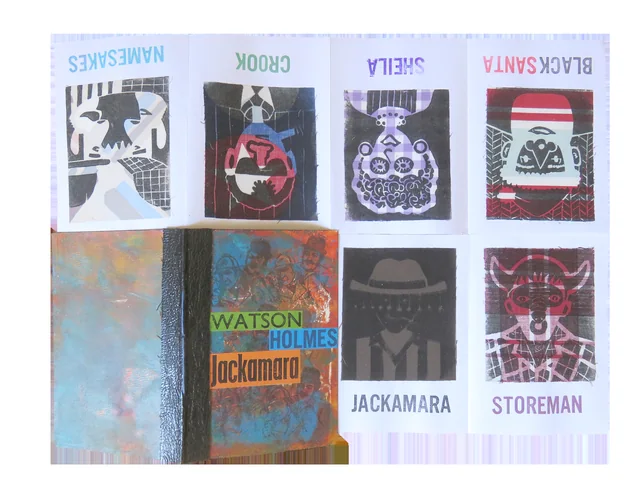
Derham Groves wrote to Mudrooroo in May 1991, and Mudrooroo wrote back from West End, Brisbane, on the 26th about the stories he had in hand, among them one that would tell how Jackamara got his name. Groves cut seven linocuts on cloth of the stories’ characters while he was an artist in residence at Bundanon, and made them into an artist’s book, Dr Watson Holmes Jackamara, in an edition of 21, with a copy of the letter on the back of the sheet.

“I recognise the connection between Australia and Sherlock Holmes and Arthur Conan Doyle.”

The Jackamara book opened out: six small linocuts on cloth, each stamped with a title, Namesakes, Crook, Sheila, Black Santa, Jackamara and Storeman, beside the closed book.
Dr Watson Holmes Jackamara, Black Jack Press, 21 copies. Photograph: Derham Groves.

Mudrooroo was born Colin Johnson in 1938 at East Cuballing, near Narrogin, Western Australia, and published his first novel, Wild Cat Falling (1965), under that name. He identified as Aboriginal, and in 1988 took the name Mudrooroo. In July 1996 Victoria Laurie reported in The Australian Magazine the research of his sister, Betty Polglaze, into their family, which traced it to an African-American grandfather, an Irish grandmother and early white settlers of Western Australia, and to no Aboriginal forebear; that month elders of the Kickett family rejected his claim to kinship in the Narrogin district. He maintained that he was Aboriginal until he died, in Brisbane, on 20 January 2019.

Sources Derham Groves, “Dr. Watson Holmes Jackamara”, 2007; Derham Groves, “Mudrooroo’s ‘Dr Watson Holmes Jackamara’”, 2026; NLA catalogue, Crimes for a Summer Christmas; More Crimes for a Summer Christmas; Murder at Home; The Canberra Times, 22 December 1990; Maureen Clark, Mudrooroo: A Likely Story, PhD thesis, University of Wollongong, 2004; Encyclopaedia Britannica, “Colin Johnson”; Paul Spickard, obituary, Ethnic and Racial Studies, 2019.

1981–2026 Derham Groves

Derham Groves, Black Jack of Ballarat

Derham Groves is an architect, and taught architecture at the University of Melbourne. His architecture thesis of 1981 was a design for a Sherlock Holmes Centre; the University of Minnesota keeps a copy in its Sherlock Holmes Collections, with his letters to the collector John Bennett Shaw. In 1985 the Baker Street Irregulars, who invest each member under a name from the stories, invested him as “Black Jack of Ballarat”; Peter Blau’s Sherlockian newsletter, Scuttlebutt from the Spermaceti Press, calls him their first Australian member. His press, the Black Jack Press, has printed his Holmes books since 1997.

He helped assemble Holmes Away from Home at the State Library of Victoria in 1987, writing in its catalogue on the early Australian productions of the plays, and has made Holmes exhibitions at the University of Minnesota and the University of Melbourne since. From time to time he set his architecture students Holmes projects: a house for one of the villains, a hotel for the Irregulars, the victims of the stories as Barbie and Ken dolls.

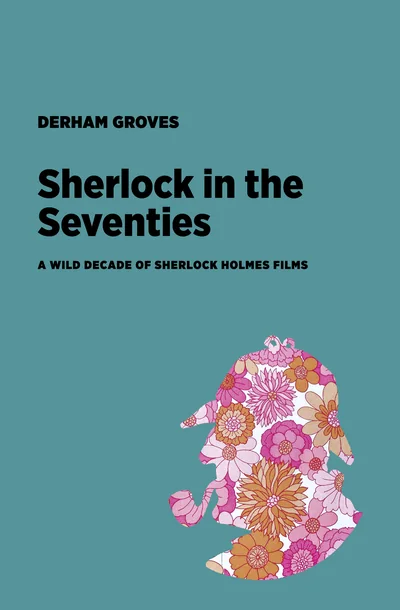
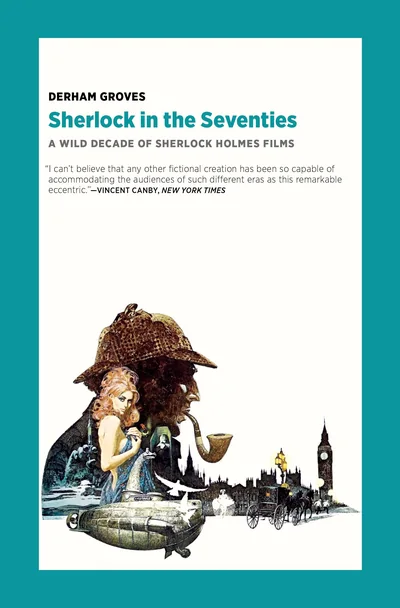
The first cover of Sherlock in the Seventies, 2021: the title in black on sea green, and a profile of Holmes in a deerstalker with a pipe cut out of a 1970s print of pink and orange flowers.The 2026 cover of Sherlock in the Seventies: the title in teal on white inside a sea-green border, over a 1970s film-poster painting of Holmes in a deerstalker with a pipe, a red-haired woman, a submarine and Big Ben.

The book of this site

Sherlock in the Seventies

A Wild Decade of Sherlock Holmes Films

Published
The Visible Spectrum (no. 009 in its series), July 2021; reissued with a new cover in 2026
Pages
268; 266 in the reissue
ISBN
978-1-953835-09-3
With
a preface by Timothy J. Johnson, curator of the Sherlock Holmes Collections at the University of Minnesota, and a piece by Peter E. Blau

Nine films of the 1970s, every one of them a different Holmes, from Billy Wilder’s The Private Life of Sherlock Holmes to Bob Clark’s Murder by Decree; Groves interviewed the casts and crews. The Visible Spectrum is part of Verse Chorus Press of Portland, Oregon, whose Dark Passage list reissued June Wright.

  1. 1970The Private Life of Sherlock Holmes · Robert Stephens
  2. 1971They Might Be Giants · George C. Scott
  3. 1972The Hound of the Baskervilles · Stewart Granger
  4. 1975The Adventure of Sherlock Holmes’ Smarter Brother · Gene Wilder, as his brother Sigerson
  5. 1976The Seven-Per-Cent Solution · Nicol Williamson
  6. 1976Sherlock Holmes in New York · Roger Moore
  7. 1977The Strange Case of the End of Civilisation As We Know It · John Cleese, as his grandson
  8. 1978The Hound of the Baskervilles · Peter Cook
  9. 1979Murder by Decree · Christopher Plummer

“This is definitely a title that I can recommend.”
The Visible SpectrumBooktopiaAmazon

His other Holmes books

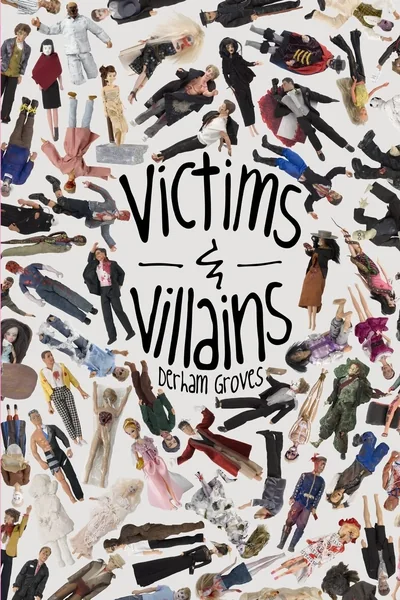
The cover of Victims & Villains: the title in black script over a scatter of small photographs of dressed-up dolls.

Victims & Villains

Barbie and Ken Meet Sherlock Holmes

Published
Ramble House, Vancleave, Mississippi, August 2009
Pages
174
ISBN
978-1-60543-338-7

Third-year architecture students at the University of Melbourne each read a Holmes story and made its victim, or its villain, out of a Barbie or a Ken doll; Groves added the architecture. The jacket is Huey Groves’s.

Ramble HouseAmazon

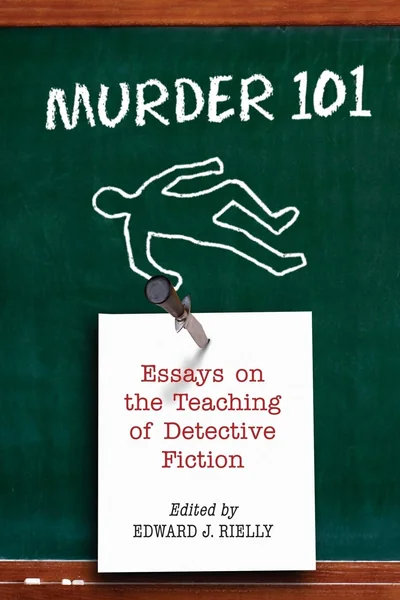
The cover of Murder 101: a chalk outline of a body on a blackboard and a paper label with the subtitle.

“Holmes Is Where the Art Is: Architectural Design Projects”

in Murder 101: Essays on the Teaching of Detective Fiction

Published
McFarland, January 2009, edited by Edward J. Rielly
Pages
61–69 of 252
ISBN
978-0-7864-3657-6

His chapter, on architectural design projects drawn from the Holmes stories.

McFarland

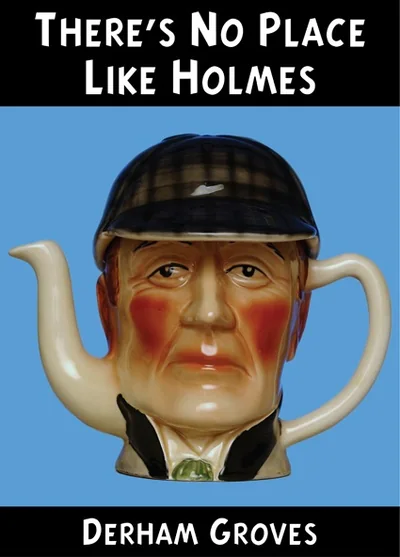
The cover of There’s No Place Like Holmes: a china teapot made as Holmes’s head, its lid his deerstalker, on sky blue.

There’s No Place Like Holmes

Exploring Sense of Place Through Crime Fiction

Published
Black Jack Press, Carlton North; catalogued 2007, out early 2008
Pages
178
ISBN
978-0-9580785-9-7

Architecture as a detective story: the Holmes stories and seven Australian crime writers read for their places, his students’ Holmesian designs, and his own Sherlock Holmes Centre.

NLA catalogue

You Bastard Moriarty

being a consideration of the collectability of ephemera related to the greatest detective that never lived: Sherlock Holmes

Published
The Littlewood Press, Melbourne, 1996; launched at the Savage Club on 15 July 1996
Edition
100 numbered and signed copies, the first ten bound in kangaroo with two drypoints and four linocuts
ISBN
1-875718-08-7

His book on collecting Holmes ephemera, “written by Black Jack of Ballarat, also known as Derham Groves B.S.I.”, with an envelope of Holmes and Watson ephemera bound into every copy.

NLA catalogue

The Black Jack Press’s Holmes artist’s books

  • 1997Sherlock Holmes: Just What You’re Looking For, 19 copiesEphemera from Sherlock Homes Real Estate, Moonee Ponds, with linocuts by Derham and Huey Groves
  • 1997Sherlockian Visiting Cards, 20 copiesA visiting card on every page; followed by More (1997), Too Many, Even More (1998) and Enough! (2003)
  • 1998Profiles by Gaslight, 21 copies
  • 19992,2,1 B-Cases from the Files of Sherlock Holmes, 21 copies
  • 2002The Re[bus]es of Sherlock Holmes, 80 copiesEight rebuses by Vane Lindesay, published by Groves
  • 2003Baker Street Businesses, 12 copiesBound in red tartan; the ex libris is a cash receipt
  • 2004Parallel Worlds: Sherlock Holmes and Tintin, 20 copies
  • 2005Villains’ Tyre Tracks, 20 copiesIn a drawstring bag with a mounted tyre tread
  • 2006Bugs & Hidden Cameras, 16 copiesBy “Altamont”, printed by “Von Bork”, in a hollowed copy of Pocket Book Weekly
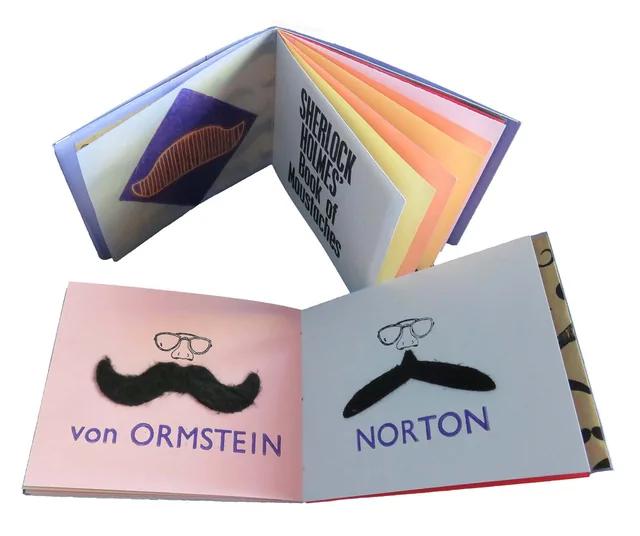
  • 2021Sherlock Holmes’ Book of Moustaches, 16 copiesJoke moustaches from a $2 shop, and a razor blade for Irene Adler
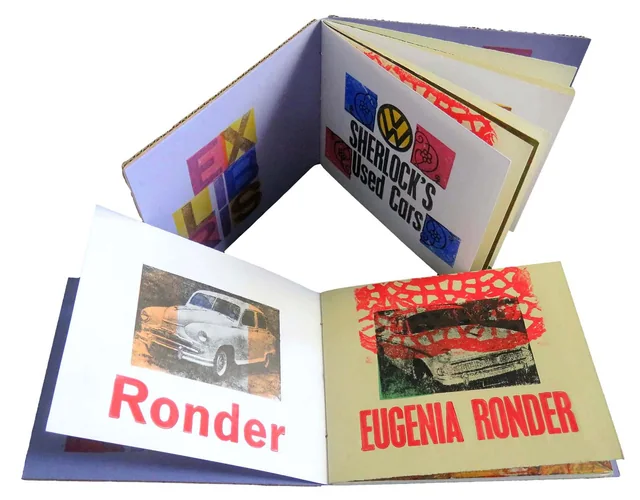
  • 2021Sherlock’s Used Cars, 21 copiesCharacters’ imagined cars, printed from 1960s used-car-yard plates
  • 2021Roylott’s Menagerie, 20 copiesA plastic snake on the cover
  • 2023The Retired Colourman, 20 copiesWith Jan Setek; paint-swatch covers in dark green pigeonholes, the colour of Josiah Amberley’s vault
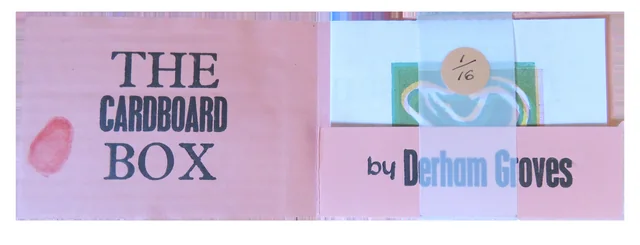
  • undatedThe Cardboard Box, 16 copiesA severed ear on the cover, in an envelope addressed to the wrong Miss Cushing
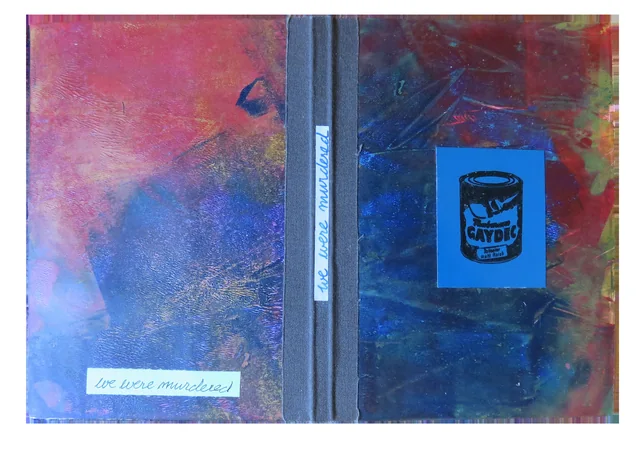
  • undatedDr Watson Holmes Jackamara, 21 copiesSeven linocuts on cloth, and Mudrooroo’s letter of 1991
Sherlock Holmes’ Book of Moustaches open at two pages, “von Ormstein” and “Norton”, each with a stick-on moustache.
Sherlock Holmes’ Book of Moustaches, 2021. Photograph: Derham Groves.
Sherlock’s Used Cars open at a page for Eugenia Ronder with a printed car.
Sherlock’s Used Cars, 2021. Photograph: Derham Groves.
The Retired Colourman: concertina strips in paint-swatch covers set into dark green cardboard pigeonholes.
The Retired Colourman, 2023. Photograph: Derham Groves.
The Cardboard Box: a pink card cover with a rubber ear fixed to it, and the title in letterpress.
The Cardboard Box, undated. Photograph: Derham Groves.

Sources University of Minnesota, Sherlock Holmes Collections, box list; Peter E. Blau, Scuttlebutt from the Spermaceti Press, January 1988; Scuttlebutt, May 2008 and March 2011; The Times (Victor Harbor), 7 April 1992; NLA catalogue, You Bastard Moriarty; Derham Groves, “Crime and architecture”, La Trobe Journal 83, 2009; Derham Groves, “Barbie and Ken Meet Sherlock Holmes”, 2008.

Read 12 October 2026 Sources

Where this comes from

The stories are read in Project Gutenberg’s texts and the Strand’s own pages; the stage, the tour and the advertisements in the newspapers of the day on the National Library’s Trove; Derham Groves’s books in the catalogues of the National, State and university libraries, the publishers’ pages and the reviews. Each part names its sources under it. Doyle’s words and the newspapers of 1902 to 1954 are free to quote; Groves, Mudrooroo and the reviewers are quoted short. Where the sources disagree, the page goes with the record made nearest the event, and the disagreement is here:

  • Sherlock in the Seventies came out in July 2021 (the publisher’s page of that month, Kate Jackson’s review, Peter Blau’s notice). Groves’s post of August 2026 dates the first cover 2023 and calls the 2026 cover a second edition; it carries the same ISBN. Listings give 268 pages for 2021 and 266 now; Blau gave 206 and Jackson 246, the text before the notes.
  • There’s No Place Like Holmes is catalogued by the NLA with a 2007 imprint and a 2008 date in the same record; Groves’s own list and Blau give 2008, and Groves wrote in August 2007 that it would be out in March 2008. The NLA has the subtitle “through crime fiction”, his list “in crime fiction”.
  • Victims & Villains is titled Barbie and Ken Meet Sherlock Holmes on the book and at Ramble House, and Sherlock Holmes Meets Barbie and Ken on Groves’s own list. Its pages are 174 (Libraries Australia), 176 (Amazon) or 169 (Blau).
  • Edition sizes: Groves gives 16 copies of the Book of Moustaches and 21 of Sherlock’s Used Cars; the NLA, cataloguing copies in hand, 15 and 20. Villains’ Tyre Tracks is 2005 on his list, [2006] at the NLA and the SLV, and “2000?” at the SLNSW.
  • Harry Plimmer was the first Holmes in Australia, at Perth on 26 July 1902 (the Perth advertisements, the Referee, Williamson’s own affidavit). A Townsville paper in 1936 gave the first production to Hastings.
  • The “brilliant artistic triumph” Groves quotes from the West Australian of July 1902 is Williamson’s own advertisement, not the paper’s review; it misprints “triumph”.
  • Hastings’s farewell: Groves gives Melbourne, June 1904; he went on to Geelong on 22 August and Adelaide on 1–2 September 1904, “Absolutely the Farewell”.
  • Williamson paid £1,000 for the Australian rights (his evidence in court, Table Talk, 25 September 1902); Groves gives “the biggest price ever previously paid”, without a figure.
  • AusStage dates the Brisbane Sherlock Holmes 14 August 1903; that was a one-night revival, and the season opened on 25 July.
  • Doyle’s own dates in The Wanderings of a Spiritualist often differ from the newspapers’: Geelong and Bendigo are both 13 October in the book, 14 and 18 October in the papers; the Melbourne Town Hall farewell is 12 November in the book, 11 November in the papers. He counts five Adelaide lectures where the papers show four, and three in Sydney where they show four.
  • Doyle writes that the family got out of attending the Melbourne Cup; Table Talk says they were at every fixture of the racing carnival.
  • The coroner line has three wordings from 13 November 1920: the Sun’s (given above), the Evening News’s “A coroner has not sat on him”, and the book’s “a coroner has never sat upon him”.
  • Groves dates the Crompton advertisement 11 July 1938; it was printed on 11 June. He gives one of the C.O.R. advertisements to the Sun-Herald of 20 March 1954; it is in the Sydney Morning Herald of that day, a Saturday.
  • Mudrooroo left Australia in 2001 (Britannica) or about 1996 (Spickard, who knew the family). Jackamara is called a Detective Inspector in some summaries; in the stories he is a constable, a detective and a Doctor of Criminology.
  • Peter Blau’s Scuttlebutt (2008, 2011) calls Groves, invested in 1985, the first Australian member of the Baker Street Irregulars; a Victor Harbor paper of 1992 says Alan Olding, who founded the Sherlock Holmes Society of Australia in Adelaide in January 1978, was inducted into the Irregulars that year. The Irregulars’ own lists would settle it.
  • Groves’s Black Jack Press has two addresses: his own in Brunswick West (1997) and Michael Jorgensen’s in Carlton North (from 2001).

Sources the National Library’s catalogue, with the State Libraries of Victoria and New South Wales and the University of Melbourne; The Visible Spectrum, 2021 page (Wayback); Peter E. Blau, Scuttlebutt, August 2021; Ramble House; Derham Groves’s posts, 2007–2026.